Know Any Literary Animal Lovers?

Hi there PureJeevan readers! We wanted to let you know that Jim's new novel CHROO is available on Amazon. It's a crazy adventure involving a billionaire heiress, her Chihuahua BFF ("Chroo") and a host of human and animal characters. Find out more on Amazon! Here are some links:
Can you believe it's mid-October already ? Here in Pittsburgh, for those lucky few who may have fig trees, that means harvest time! Well, almost. Take a look at this video we made about figs!
As stated in the video, we did a previous installment on figs in our Know Your Food series (which will definitely be returning once we finally sell our home and become full-time raw food inspiration providers!). Please visit that link for nutrition and other information on figs.
We'd like to welcome the RawFoodRightNow blog readers to our Pure Jeevan blog! We are a new blog (started earlier this month), so we are thrilled that you have already found us and have taken the time to come and meet us!
Our blog is focused on a holistic look at living life as a raw food vegan (we have a holisitc raw-focused newsletter, too). We write posts that cover the body, mind, spirit, and emotions--as well as just random talk straight from our hearts to the blog page.
We update at least five times per week because we have daily blog features (Makin' It Monday, where we share raw recipes we are making; Take the Time Tuesday, where we introduce people or businesses we think may interest you; Weird Wednesay, where Jim shares observations about strange things; Thankful Thursday, where we share what we are thankful for and ask you to share, as well; and Fun-Filled Friday, where we tell you what fun things we have planned for our weekend).
I like this "travelogue" format, so let's continue! Here's Wendi's comments from their adventures in San Luis Obispo, checking out the raw vibes along the CA Central Coast!
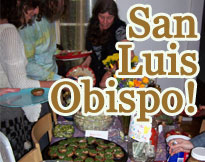 After a very active visit in the San Francisco / Berkeley area, we headed down the coast to San Luis Obispo, CA. There's a pretty active raw food meetup there and we were asked to stop in their town to give a talk to their group.
It was a nice drive south, but the sun is a bit brighter than we're used to (especially when driving long distances). When we arrived in the town, we were overcome by the beauty of the place. It's one of the most beautiful places we've seen in California, so far!
Read more: The Friendly, Mellow, Raw Groove of San Luis Obispo

Welcome to Makin' It Monday, Guest Raw Chef edition. Today, Dave Sokulski of www.BirchCenter.com and www.FoodUnderFoot.com gets a little silly while making some delicious raw cacao treats! Enjoy the video:

Welcome to Pure Jeevan's "Juice-a-Day Jamboree"! You're probably wondering, "What IS Pure Jeevan's Juice-a-Day Jamboree, anyway "? Well, it's simple:? It's an ongoing, informal, loosely organized "event" centered around juicing. Think of it as an interim step between (1) any kind of diet or lifestyle, from SAD to full-on raw, that does not include much regular juice, and (2) an all out juice feast where that's ALL you'd consume for a period of time. Basically, we're saying, "Let's just make this simple and accessible for everyone. Let's just make a goal to simply drink more fresh juice!"
Wendi and I have been thinking a lot about incorporating more juicing into our lives lately (which is something we've done off and on over the years but never stuck with long-term). One thing holding us back from doing it more often is the time requirement. When we juice, it usually takes a half hour or so from start to finish. I know it doesn't seem that complicated, but I suppose it's just the whole process of setting up the juicer, washing and peeling the produce, juicing it, setting the juice aside while we clean the juicer, doling out the juice into glasses, cleaning up the mini-mess that makes, and then sitting down to actually enjoy the juice.

Recently, the wife of a friend of ours decided that she wanted to lose 20-25 pounds. As far as we know, she follows pretty much a "Standard American Diet." We've heard that she doesn't care for red meat, but she does eat other meats, plus a good deal of dairy (which, we believe, she regards as a healthy food choice). She's apparently tried a number of exercise regimens, and a few fad diets, with no luck on losing these 20-25 pounds. (Frankly, we haven't seen her many times, but would not have guessed that she had 25 pounds to lose. But, we'll save "self image" as a topic for for further posts.) In any case... Frustrated, she decided to see a hypnotist!
Our friend accompanied his wife to the initial consultation. He said it was actually interesting. The hypnotist basically sits you down and walks you through some fundamental psychology, demonstrates a few of the primary principles of suggestion (e.g., showing you how easy it is to, say, imagine the sourness you would experience when biting into a slice of lemon), and then lays out how the program works.
Persimmons are a tad unusual, aren't they? Perhaps they're simply uncommon. After all, few major grocers carry them regularly (at least, not in our area). But, occasionally, they crop up as a specialty, limited-quantity offering. That's more or less how we obtained some recently. Wendi *loves* them, so we quickly snatched up a few at our local co-op last week. Here's the vid (below).
Thanks again to BH and Janet McKee for being our special guests for this episode.

Many of our visitors go directly to our raw food recipes section of the blog. They must be terribly disappointed to find only a few recipes there. We ll continually add more, but for now there are only a handful. So, it is with extreme pleasure that we introduce you to someone you are going to love!
Take the time to meet...

It's been a while since we've made any major design changes around here. So, we thought a redesign was in order -- and we're happy to announce that we're about 95% finished implementing the new look. It's live and working right now, so we invite you to take a peek.
 So many things have changed and/or been updated, not the least of which is the general look and feel of Pure Jeevan. (We did base the new design on much of the look and feel we established many years ago. But, the site has now been modernized -- adding a third column, leveraging more complex style sheets, and integrating more with social media sites like Facebook, and quite a few behind-the-scenes programming updates.)

In some wonderfully literary sense, there must be some kind of unique metaphor that could be constructed around the process by which cabbage turns to kimchi. Personal growth is not always easy, as any success technologist will surely tell you; ?there's a lot of doubt and oozing and off-gassing involved -- and yet, the final product is surprisingly pleasing to the palate.
Yes, it's time for us to update you on our first-ever kimchi experiment. If you want the short version:? I believe we have been successful! For those of you with a few more minutes, I'll share some of the lurid details. Highlights of our experiment included:
The other day, before grocery shopping, I didn't have a lot of food in the house. When that happens, I usually take a look at what I have and then try to come up with something tasty. It's kind of an art form, to create something out of next to nothing. I think I learned the art from my mother, who had to make things stretch on a very minimal budget.
Here's what I created, and it turned out great!