Know Any Literary Animal Lovers?

Hi there PureJeevan readers! We wanted to let you know that Jim's new novel CHROO is available on Amazon. It's a crazy adventure involving a billionaire heiress, her Chihuahua BFF ("Chroo") and a host of human and animal characters. Find out more on Amazon! Here are some links:

It's always a journey.
That's basically my post today, boiled down into four words. From all I've read, from all of those I've talked with / emailed / interviewed, and certainly from all I've personally experienced, this is a key concept that, in my view, it's best to come to terms with as soon as you can.

Let me take you down,'cause I'm going to
Strawberry Fields.

Since Pure Jeevan specializes in raw food weight loss, we receive a lot of questions about what is required in order to lose excess weight. Many individuals want to know if they need to go on a 100% raw food diet in order to release excess weight.
The answer is, "No, you do not need to switch to a 100% raw food diet in order to lose weight." If you're asking if a 100% raw food diet works better for losing weight than slowly transitioning and increasing your raw food intake, the answer is still, "No."

We have two events scheduled for this weekend and we are looking forward to both of them! The first is a Raw Food Potluck Meetup. I haven't decided what I'm creating, yet. So far I'm thinking I'll make either an apple pie or some beet noodles with alfredo sauce, but I know how things usually go when it's time for me to prepare something special. I usually feel like I don't want to make what I had planned, and I search around in the fridge to see what pops out at me. I almost always go by what I'm inspired to create at that moment. So, who knows what I'll end up making. I'll try to take pictures of my creation as well as pictures of the other raw food dishes that others bring.
This will be our first raw food potluck. When I first went raw it was something I was doing special for myself, by myself, so I didn't join any of the raw food meetups and didn't want to make it a group activity with my friends.After two years of raw (a little over one at 100%), I've done (and continue to do) what I needed for myself.Now, I'm ready to share my experiences with everyone and to be an active member of the raw food community.So, I'm looking forward to the raw food potluck tomorrow!? You are welcome to join us at the potluck if you are in the area!
Hey everyone!? Just one long weekend left for Wendi and KDcat to (frantically) pack for their cross-country roadtrip. Yep, Monday night I'm dropping them on that midnight train to Portland. Wait until you see the spread of trip-snacks they're taking along. (We took some pictures of the raw foods smorgasbord sent by our generous snack sponsor, Natural Zing).
Today, since it's fun-filled Friday, I thought I'd share a little tale of frustration (although meant in kind of a funny way) relating to my own diet. You may have read my mini-manifesto a few weeks ago about my recent quest for simplicity. Well, Wendi and I have both largely maintained that kind of existence for a while now -- especially when it comes to the breakfast smoothies (pineapples galore!) and lunch salads. I have to admit that my energy seems to be trending upward very nicely!
I started writing on a raw food forum about the oranges coming in today. But, I was on my way out the door and I had more to say about them than I realized, so, I figured I'd paste what I wrote, so far, and add to it here in our blog. ;-)
?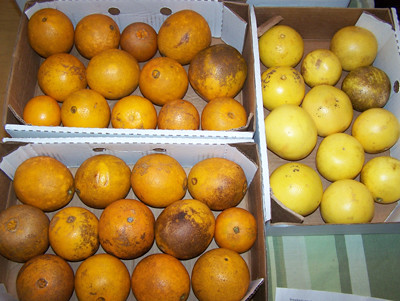
(organic oranges and grapefruits)
I like this "travelogue" format, so let's continue! Here's Wendi's comments from their adventures in San Luis Obispo, checking out the raw vibes along the CA Central Coast!
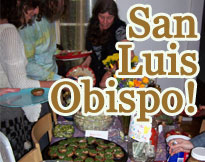 After a very active visit in the San Francisco / Berkeley area, we headed down the coast to San Luis Obispo, CA. There's a pretty active raw food meetup there and we were asked to stop in their town to give a talk to their group.
It was a nice drive south, but the sun is a bit brighter than we're used to (especially when driving long distances). When we arrived in the town, we were overcome by the beauty of the place. It's one of the most beautiful places we've seen in California, so far!
Read more: The Friendly, Mellow, Raw Groove of San Luis Obispo

We had a wonderful weekend that started with a raw food potluck in our home (through the Pittsburgh Raw Food Meetup group). There were about twenty people and so many lovely raw food dishes! I haven't checked the camera, yet, but I hope someone remembered to capture some pictures of the food and guests. It was all very yummy, including the beet pasta I made with a cream sauce. I also made some carob peppermint sweets that KDcat formed into bite-sized balls and arranged them on a platter. A friend of mine told me that the people who show up for raw food potlucks tend to be genuinely nice people, and she was right. It was a pleasure meeting everyone and I look forward to next month's meetup.
The rest of our weekend was spent with our guest, Devaki, who just left a few minutes ago to return to the ashram. She played some beautiful music on the harmonium and she and some other lovely guests filled our home with the beauty and energy of Kirtan chanting. Some of the chants were in English, too. I thought I wouldn't like them as much, but they were just as beautiful as the Indian ones. One of my close friends who was here for the Kirtan told me that I was glowing after the chanting! I love the blissful feeling that comes from chanting and meditation.

Jim here... Here's an interesting way to finish out the week: Today just happens to be my one-year "rawniversary." That's right, for the past full year, I've existed as a 100% raw food vegan.
Sure, I'd been "high-raw" for a couple of years prior to September 18, 2008 -- and it was during those high-raw years when the bulk of my weight came off and when I kissed prescription meds goodbye (I'd been on powerful beta-blockers for my heart and blood pressure).

A month has gone by since my last health update. At this point, I consider myself healed of lyme disease! In the past I asked the lyme specialist doctor if there's a way to test to see for certain the lyme is gone, but he said there isn't. So, I go on my inner wisdom, which tells me that it's gone and now I simply need to continue healing from all that the lyme brought with it.
We're still not comfortable sharing what we've been learning and doing to help move my body into an even healthier state, but it's obviously working. I've been able to go back to daily living, for the most part, without much assistance at all. I've organized the house again (Jim and KDcaT were busy caring for me and the house wasn't the top priority for the past half a year), caught up on all of the laundry, responded to all of my email that had been piling up, and I've been able to be more social again. The biggest improvements are that I can now prepare my own food without experiencing any pain, and I can dress myself with only minimal assistance at times! BIG improvements!
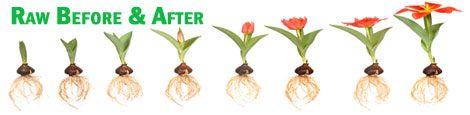
Yesterday, we covered the concept of "unsubscribing" from unhealthy practices. This was of course based on the common Internet practice of subscribing and unsubscribing to various things like newsletters and email lists. I receive quite a few of these each day, many raw foods ones and many non-raw ones. Among the non-raw, one that has been interesting to me lately is called the Art of Non-Conformity, penned by Chris Guillebeau. Basically, Chris' site chronicles his adventures in reaching his personal goal -- to travel to every country in the world! Along the way, he writes about all sorts of out-of-the-box things, as the blog name implies.
Today, he posted something that is remarkably insightful and applicable to our subject matter here, even though his context was completely different. The entry, entitled simply "Before and After," discusses the drinking water problems in much of Africa, focusing for the moment on Liberia. Atop the piece (the "before" picture) is a muddy water hole, the only source of drinking water for one village. The next picture (the "after" shot) shows a different, very happy village obtaining fresh, clean water from a newly installed well. Chris closes his article with the following quote: