Know Any Literary Animal Lovers?

Hi there PureJeevan readers! We wanted to let you know that Jim's new novel CHROO is available on Amazon. It's a crazy adventure involving a billionaire heiress, her Chihuahua BFF ("Chroo") and a host of human and animal characters. Find out more on Amazon! Here are some links:

Today we revive our occasional "Thankful Thursday" feature to give thanks for a special Internet destination: Twitter.com. We're sure a number of you who may be unfamiliar with Twitter may be asking, "What in the world does this have to do with raw foods "
In fact, there's quite a bit of raw foods "activity" on that site! But first, let's take a look at what Twitter is. Basically, it's a web site where you sign up with a username, and then you answer the question, "What are you doing " in 140 characters or less.

As many of you know, I'm more of an intuitive eater than anything else. I eat what I intuitively feel my body needs most of the time. Well, for the past two weeks what my body has been asking for is cauliflower. I went through a cauliflower stage sometime last year, and it seems I'm back to eating that lovely white flower veggie again!
At first I was making mashed cauliflower (like? mashed potatoes) and keeping the recipe very simple. I've made complex versions of the mashed cauliflower before, but I was really drawn to a more simple taste so all I was adding was some olive oil, salt, and a tiny bit of macadamia nuts. Yesterday, however, as I was cleaning the cauliflower (since my body was telling me it wanted more of it), I had a sense that I wanted something more vibrant, more fun than simple mashed cauliflower. So, I followed my intuition (picking up whatever I felt my body wanted to eat with the cauliflower) and here's what I created...


When we found out that there was a raw foods restaurant in Key West, we knew we'd visit for sure. So, after a wonderful lunch of some of their raw staples (raw tacos and peanut noodles), it was no surprise to us that we found ourselves drifting back toward Help Yourself after the sunset celebration at Mallory Square (the main nightly Key West sunset viewing celebration). When we arrived, we asked to interview the owner, Charlie Wilson. She'd just left after working a very long day at the restaurant. But, an emplyee called her anyway and she graciously agreed to come talk with us! So, here's a bit of that conversation:
Read more: The Key West Raw Scene: Pure Jeevan Gets Up-Close and Personal with Charlie Wilson!

Sixteen years ago today, our beautiful KDcat (now called Bailey) was born!! Happy, happy birthday to Bailey. We hope ALL your wishes come true and you continue to shine your bright light and express your creative talents for the rest of us to enjoy!

 Here it is: Putting it all together. Here you'll see what we use for our taco shells and how we build up our taco. Quite often, we also make a raw sour creme using cashew nuts and lemon juice. But, for these tacos, it'll just be meat, salsa, and guac. Enjoy!
Jim here... Since many people have asked me how she liked the surprise gift, here's a quick, unedited video taken last Saturday on Wendi's birthday. We had gone to the park that evening to hang out and catch some fresh air. I took a few minutes to ask her about her day, and thought I'd share this with you.If I showed you the video of her receiving the gift that morning, I'm afraid all you'd see would be tears all around the dining room table. (We were all rather emotional about it.) So, take a look at this video for now. Wendi said that she wanted to write something here as well. So, that will no doubt be coming soon.
By the way, at the end of this video, Wendi mentions another video of a man we interviewed earlier that day on Wendi's birthday. I was going to edit some of that in, but we decided to run that video here on its own this Thursday because it addresses a question Wendi gets quite often. You'll love that video, as it's a great testament to the power of raw foods. For now, I hope you like the above vid (even though there's a fair amount of dog posterior that I should have edited out - LOL).
Read more: Wendi Dee Interviewed About Her 25th Birthday Surprise!
I was sitting here today thinking about all of you, our lovely online friends who visit this blog. You follow what's going on with us, learn from us, find inspiration in the things we share, and even offer support to us in many ways.
Some of you reach out by leaving comments, many of you send emails, and a larger majority of you are quiet friends who haven't made contact with us, yet. Each and every one of you means so very much to me (and to Jim, too).
We don't keep this blog for ourselves; we keep it for all of you. It is our desire to share all that we've been through, and what we've learned, in order to help you with your own journey. Most of all, however, my personal desire is to inspire you to live the life you truly want to be living (in more ways than just through what you eat).
I don't have time to write a real blog post, but wanted to pass along this information for anyone who eats Halloween candy, or knows of others who do. Please note that I am not the kind of person to spread false warnings. I completely trust Mike Adams as a Health Reporter and all around wonderful person. He would not spread false news...he looks into every bit of information available before sharing what he's learned with everyone else.
Mike has issued a warning about Halloween Candy. Please go to his site to find out more about it: NaturalNews.com
?
I'll leave you with an old Halloween picture of me before I started eating raw foods. Halloween used to be the day I'd dress up and feel okay being myself, because I was in costume. It's funny to me that this year I feel no need to cover up in order to be myself. Halloween is still my favorite holiday, however!
The Environmental Working Group publishes something really useful called the Shoppers Guide to Pesticides. In it, they offer two handy lists: (1) The Dirty Dozen -- conventionally grown produce items that contain the most residual pesticides, and (2) The Clean 15 -- conventionally grown produce items that contain the least residual pesticides.
While we believe that organic is always best, there nonetheless are times when most of us (for whatever reason) consider purchasing or consuming conventionally grown (meaning "sprayed with pesticides") produce.
Read more: Mnemonic for the "Dirty Dozen" Foods that You Should Only Buy if Organic!

What do you do when you spend the night or week-end at someone's house and they're not raw. Do you take your blender and all that
Super question, Joanna!? I'm sure you also have a great answer for this. I think I do, too, but it's probably more complicated than a lot of people would like.For me, the factors that complicate the "travel to non-raw households" issue include, but are not limited to:
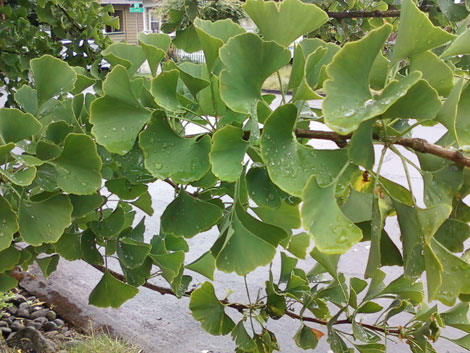
Ahh, yes... Ginkgo Biloba. What a distinctive tree, don't you think? So easy to identify, and so many reported health benefits. This one belongs to a neighbor that seems to have an affinity with Asian landscaping motifs. They also have gorgeous bamboo growing in their yard, and other Asian elements. I would have liked to have harvested some leaves to dry for some Ginkgo tea, but the owner wasn't around to ask. Perhaps some other time.