Know Any Literary Animal Lovers?

Hi there PureJeevan readers! We wanted to let you know that Jim's new novel CHROO is available on Amazon. It's a crazy adventure involving a billionaire heiress, her Chihuahua BFF ("Chroo") and a host of human and animal characters. Find out more on Amazon! Here are some links:

A Pure Jeevan family members asks:
How do I eat dandelions? I heard they are good for me, but I tasted one and they are so bitter. I don't know how I could ever eat them, even if they are supposed to be so good for me. Can you help
First, congratulations on being so open-minded when it comes to trying new things! Too many people never move far away from their comfort zones, especially when it comes to diet, and they miss out on a lot. So, good for you to at least consider and then try dandelion greens!

Pure Jeevan is hitting the road? this weekend, heading to Chicago for some super-double-secret raw business stuff, returning late Monday. (Can't discuss it yet, but it's raw food related and ultra-cool. We'll get to it in due time, I promise.)?
Actually, it's going to be quite an interesting trip, as we have some very serious, very intense work to do in Chicago over the entire weekend, but we're not sure yet whether it'll be Wendi doing the work or me! It all depends on how Wendi feels -- and with Lyme, you just never know. So, one of us will be busy, the other largely free to explore the windy city with KDcaT and Th' Jooge.
Read more: Pure Jeevan Hitting Chicago This Weekend. Suggestions Anyone?
There's SO much to celebrate lately! Check it out:
 Our dear friend Robin (aka Rawbin) celebrates her birthday today. We created a fun video for Rawbin, who has the ability to make anyone laugh! Rawbin blogs here and you can read her "My Raw Story" installment here.She's also the east coast Raw Spirit Festival representative. (RSF east happens August 29-30, 2009 in Maryland. More info here.)
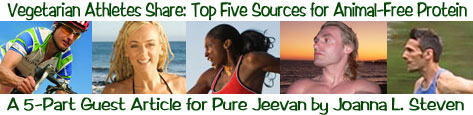
In this special five-part series, Joanna Steven uncovers where some top vegetarian athletes get their protein. Here's part two, focusing on Koya Webb's take on this issue.
ALMONDS
?The greater the percentage of raw food in the diet, the greater the health benefits? is Koya Webb, fitness model, personal trainer, triathlete and body builder's personal motto. Koya's sculpted physique won 1st place in the Ultimate Fitness Events "Fitness Model" and "Bikini Model" competitions and has modeled for Nike, Adidas, New Balance, Muscle and Fitness, Her Sports, Royal Caribbean and Triathlete magazine, to name a few. As a living-foodist (one who eats 60% or more uncooked veggies, nuts, seeds, and super foods) Koya believes eating all natural ?fruits of the earth? can help heal cancer, diabetes, and other diseases plaguing our society today.
Read more: Vegetarian Athletes Share: Top 5 Sources for Animal-free Protein (Part 2 of 5)

Wow, we've been getting a lot of publicity lately.(We'll be writing more about that later.) We're thrilled to be recognized for the work we're doing for the raw food community!
For those newly acquainted with Pure Jeevan, you've already found our blog (this site), and likely our main site. But, we also wanted to highlight another offering we've put a lot of work into -- the All Raw Directory. Here's a screenshot:

And you thought Apple Cider Vinegar was tough to pin down ? Ever come across the whole fluoride controversy
A Google search on "fluoride" returns 6,300,000 results.A Google search on "fluoride toothpaste" returns 246,000 results.
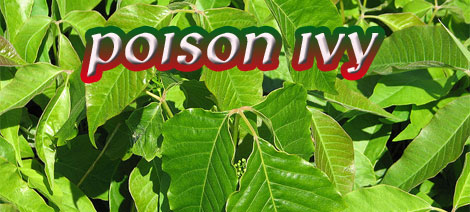
Jim here... Well, I may have lived 100% raw for nearly one year now (and mostly raw for a few additional years), and I have definitely witnessed the reversal of many physical ailments during that time, but I can say with certainty that, if raw actually cures people of allergies, it looks like I still have a ways to go before reaching that milestone. Here's a snippet from an article I published a few years ago in a book:
I believe I was roughly 12 upon learning of my allergy to poison ivy (the hard way, naturally). By age 14, I'd heard all of the poison ivy folk lore and "wisdom" out there -? that sensitive people like myself can inadvertently contract it via smoke from a nearby brush fire, that ingesting the plant's concentrated essential oil can reverse one's sensitivity to outbreaks (even, some said, to the point of complete immunity), that scratching spreads the rash, that scratching does not spread the rash, that going to get the shot and the steroids makes it fade more quickly, that calamine is best, that it's not, et cetera.

For my Fun-Filled Friday and this entire weekend, I'm going to do something fun that I rarely get to do. What is it? It's nothing...literally NOTHING! What's the fun in doing nothing? Well, to be honest I think it's impossible to do nothing. If you decide to stay in bed all weekend, doing nothing, you are really doing something--staying in bed all weekend. Right?
So, what will my nothing include? Who knows! That's the beauty of doing nothing---I have no preset plans, no expectations of myself or others, nothing at all! I have lots of things to do, of course, but I'm not doing any of them this weekend (no working on Pure Jeevan activities, no cleaning the house or doing laundry, no working on the computer, no organizing future plans/activities, no fancy meal preparations, etc.).
I receive many questions from our readers, and I am very happy to respond. I truly love helping others, but I don't do it just for them.When I was younger, many times I thought I was performing selfless acts of kindness whenever I'd help others. However, now I realize I am experiencing pleasure by helping others. I find it very rewarding, as though I am fulfilling my purpose in life.
Do you know what your life's purpose is? Do you believe there is such a thing These aren't rhetorical questions; I'm really interested in hearing your response. Well, I've known my life's purpose (actually, I have more than one) from a very young age, but it wasn't until recently that I began living it more fully. My purpose in life is to love others---to connect with others through an immensely deep and genuine love.One way I've found for spreading my love and realizing my purpose is by helping others.
When I answer questions for our readers, I speak from my heart. I think it's important to realize, however, that the answers we receive from others are *their* answers to similar questions. Maybe their answers will work for us, but maybe they won't.I've stressed this many times, but it never hurts to repeat it: Listen to others, hear what they have to share, but mostly listen to your own inner voice. We all have the answers deep within ourselves, even if we can't always hear them very well.
Read more: Life's Purpose and Reader Questions: Emotional Eating
I was sitting here today thinking about all of you, our lovely online friends who visit this blog. You follow what's going on with us, learn from us, find inspiration in the things we share, and even offer support to us in many ways.
Some of you reach out by leaving comments, many of you send emails, and a larger majority of you are quiet friends who haven't made contact with us, yet. Each and every one of you means so very much to me (and to Jim, too).
We don't keep this blog for ourselves; we keep it for all of you. It is our desire to share all that we've been through, and what we've learned, in order to help you with your own journey. Most of all, however, my personal desire is to inspire you to live the life you truly want to be living (in more ways than just through what you eat).

To help keep all of you inspired, we ve asked some
remarkable individuals to share their raw food stories with you. Enjoy!