Know Any Literary Animal Lovers?

Hi there PureJeevan readers! We wanted to let you know that Jim's new novel CHROO is available on Amazon. It's a crazy adventure involving a billionaire heiress, her Chihuahua BFF ("Chroo") and a host of human and animal characters. Find out more on Amazon! Here are some links:

Hey everyone!? I hope you're doing well. We started out the week with a great video from Joe, Tracey, and Heather. I thought I'd stay with the video blog format for a while, as I've been capturing some outstanding stuff here in Chicago. (We're here until Thursday.)? Well, a few of the vids are "okay," but the bulk of them are absolutely amazing, so be sure to check in every day for these great Chicago vids. (BTW, I'll dub this series, "The Chicago Raw Food Scene," although partially misleadingly so, as the videos are not always *about* Chicago, per se. Rather, we shot all of the videos *in* Chicago. So, pardon the slightly misleading banner graphic.)
Read more: Veritable "Wal Mart of Produce" Discovered in Chicago, Pineapples for $1.49!

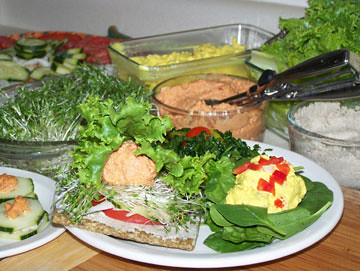
I'm still working on the dishes that will be served at the upcoming 3-Day Raw Food Spiritual Ashram Retreat (only 2 spots left!). Today, I worked on the Sandwich Fixin's that will be served for lunch on one of the retreat days.
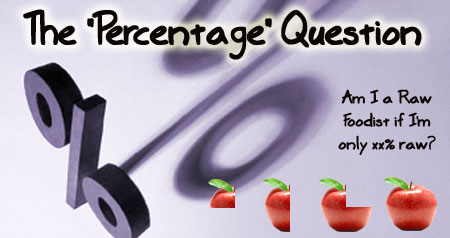
Jim here... "Do I Need to Eat a Certain Percentage of Raw Foods to Call Myself a Raw Foodist " This seems to be a common question among some people interested in pursuing a raw and living foods lifestyle. I fielded such a question recently online, and thought I'd recap my own answer here, somewhat edited for enhanced clarity:
I know what raw foodism means. And, if you're here, you probably do to, or at least you're interested in it and know the basics. But, to the mainstream population, raw is absolutely unheard of, totally out of the box -- relatively speaking. So, let's begin by taking a look at who in the world has potentially heard of RAW. Let's start more broadly and then hone in.
Read more: Do I Need to Eat a Certain Percentage of Raw Foods to Call Myself a Raw Foodist?
In this special five-part series, Joanna Steven uncovers where some top vegetarian athletes get their protein. Here's part one, focusing on Tim VanOrden's take on this issue.
When alternatives to the Standard American Diet are discussed, protein is on everyone's mind. There are many reasons why someone might want to eat a plant based diet, whether for allergy concerns, health reasons, or more variety. But nagging doubts often come up;? Are plant proteins adequate for athletes and body builders ? Are they really the preferred protein source of the human body ? Are they better than animal based protein or are they just consumed for environmental reasons ? To answer these questions, why not ask the experts:? triathletes, professional dancers, bodybuilders and extreme sport racers ? Here are the answers from some of the most competitive athletes in their respective fields.
Read more: Vegetarian Athletes Share: Top 5 Sources for Animal-free Protein (Part 1 of 5)

Day 7: Happy Navratri! It's the final three days, and today begins the special day of focusing on the attributes of Goddess Saraswati, recognizing those same feminine qualities within ourselves, and drawing inspiration to continue growing and changing in the most wonderful ways.
 Saraswati has always held a place of honor in our home. When we traveled to India a very long time ago(*), we purchased a batik wall hanging of Goddess Saraswati and framed it. It's quite large and we've always hung it in places where we wanted to focus on the energy that she represents to Hindus: creativity (particularly in the areas of music and art) and knowledge/intelligence (usually linked with education and literature).
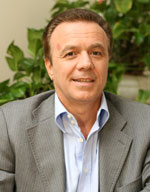 Today's post isn't specifically about raw foods. But, we wanted to post a few videos highlighting some interesting research by an Italian doctor named Tullio Simoncini, who just might be onto something HUGE! Dr. Simoncini treats certain cancer patients with ordinary sodium bicarbonate (baking soda), based on his premise that cancer is a fungal problem and that a solution of baking soda is anti-fungal. Naturally, he's been vilified by the medical establishment for making such a seemingly simplistic claim. But, what if he's right?
Here at Pure Jeevan, we're very much into health research -- not so much with an aim to cure any specific disease or ailment, but rather to understand ways in which our bodies can become what we like to call unbalanced, as well as the ways in which we might return our bodies to proper balance, when necessary. In this way, I suppose that we, like many in the natural health world, feel that the body is amazingly capable of healing itself (in many circumstances) as long as the body is able to find a favorable state from which it can properly do what it naturally wants to -- which is to return the body to an optimal state of health.
Medical doctors don't buy into this theory very much. ?However, it's certainly ironic how, where certain areas of standard medical practice are concerned, what I described above is exactly what doctors do. Take something like a broken bone, for example. A doctor does not normally attempt to surgically repair the bone itself. Rather, the standard and time-honored practice is to set the bone (say, with a cast), and then to let your body heal the break naturally, on its own, making those skeletal connections as only the imponderably complex, ever-evolving wisdom of the human body can facilitate. (True, doctors do often intervene these days with surgery for broken bones. But, their aim there is mainly to position the bones for proper healing, and/or to do things like insert pins in an attempt to improve functionality after healing. Either way, the procedure here still relies on the body's ability to eventually heal the problem.) Standard medical knowledge in this area is without question outstanding -- and this is why most people in the natural health world have little problem with going to see a medical doctor for emergency treatment.
Read more: Is Cancer a Fungus? Considering the Work of Italian Dr. Tullio Simoncini

To keep all of you inspired while we are away, we've asked some
remarkable individuals to share their raw food stories with you. Enjoy!
In Part 5 of this 5-Part series, Wendi talks with Leela Mata about meditation and diet. After discussing what meditation is and why people practice it, Mata Ji talks about diet and its effects on the mind. She then gives a brief explanation of how to meditate for those who are new to the practice, and demonstrates how to use a simple mantra (word or phrase) to aid in entering a meditative state.
Jim here... Yesterday, Wendi toughed it out and typed up a lengthy health update (a painful process for her -- trust me!). So, for the rest of this week, I'm going to fill in here (letting her get back to her resting and healing) and share a few interesting stories related to this Lyme adventure. But first, I wanted to add that today brought some great improvements in Wendi's condition. She was able to do a physical movement (wrapping a towel around her head) without pain for the first time in months. So, we really think those antibiotics are starting to kick in.
Today's topic is intuitive eating. I'm certain we've covered this many times on the blog here. So, rather than explain what it is again, I'll just share an intresting example. Basically, while dealing with these Lyme symptoms, Wendi experienced a serious craving for olives.
Mmmmmmmmm! ?I'm sitting here at my computer eating the Best Organic Fuji Apple Ever. Don't believe me? ?Here's a picture of the apple I'm eating right now:
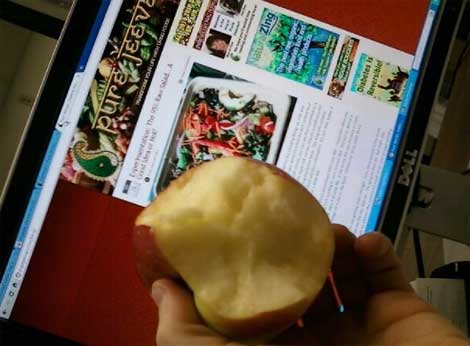
Looks dee-lish, right? ?(Okay, so maybe it's not the most appetizing pic in the world...) ?Anyway, one interesting thing about this apple is that I bought it (a whole big bag of them, actually) because it was so cheap. (I'm on a relatively tight budget these days.) ?But, if it was so cheap, how could it be so tasty? ?(And organic, too!) Well, that's where the basic law of supply and demand come in. Whenever a crop is at the peak of its season, the supply rises considerably. Instead of the store receiving X number of bushels of apples, they receive 5X or more. So, they slash prices to move that kind of volume.
Read more: Delicious Idea for Produce... Putting the Economics of Raw Foods to Work For You!