Know Any Literary Animal Lovers?

Hi there PureJeevan readers! We wanted to let you know that Jim's new novel CHROO is available on Amazon. It's a crazy adventure involving a billionaire heiress, her Chihuahua BFF ("Chroo") and a host of human and animal characters. Find out more on Amazon! Here are some links:

Sometimes you meet someone and you just know they have tapped into something special, something most of us search for but never quite find. That was the case when I met this lovely woman I'd like the rest of you to meet. There's a centered peace about her, down deep in her core, and yet she's overflowing with an energy that I've never seen matched by anyone else. She's delightfully insightful, intelligent, and playful all at the same time. ?
Take the Time to Meet

The new Vitamix container arrived within two days (they knew we were hard core Vitamix users and put the container in the mail the day we ordered it to replace the broken one). So, what was the first thing we made in our shiny new container (after washing it, of course)? A DELICIOUS coconut smoothie!


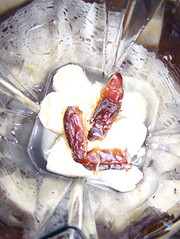

Here's Part Two of our interview with Hatice Yavuz, co-owner of Cousin's I.V. raw restaurant in Chicago. Yesterday we talked a lot about Cousin's restaurant and the stories behind that (as well as some interesting notes about European and Turkish culture and attitude toward raw foods). Today we'll get into some of the effects experienced by many after going raw -- things like raw food detox and the strengthened connection between mind and body. Interesting stuff!

Jim here... I'm back from Raw Spirit Festival East with roughly 4 Gigs of pictures and videos to sort through, as well as 17 pages of handwritten notes about my rawsome experiences. So, tomorrow, I'll begin the task of sorting through it all and posting all sorts of fun stuff (photos, videos, and tales of adventures).
For now, all I'll say is that Rawbin Anderson, RSF East Manager, did a spectacular job in orchestrating the whole event. Here's Rawbin:
Welcome to Episode 4 of Know Your Food. Wow, the PEAR episode is here at last! Aren't you thrilled to know that? Of ALL of the fruits, veggies, nuts, seeds, herbs, etc. in the knon world, we finally got to the wonderful pear. Well, it's no surprise, when you think about it. After all, sweet, mild pears are usually among the first fruits fed to babies. So, chances are, you were fed them, too, as a toddler. So, let's dig in, shall we?
Pears contain water-soluable fiber (pectin), Vitamin A, Vitamin B1, Vitamin B2, Vitamin C, Vitamin E, Copper, Potassium, Posphorous, Folic Acid, Niacin, Iron, Magnesium, Sodium, Sulphur, Calcium, and more! They lower your blood pressure, releive inflammation, lower cholesterol via pectin, calm the stomach, cool the body, prevent cancer via anti-oxidants, boost your energy via the fructose/glucose, reduce inflammation, help your bones/calcium levels, aid in pregnancies via the folate, and much more. Pears are GREAT for you, so eat them regularly!
I love this video, in which Wendi interviews our new Portland-based realtor, Bill Futrell. It's a nice interview, but I love the way Wendi's enthusiasm for raw foods rubbed off on Bill almost immediately. There's even a moment in here in which Bill starts talking about Natural Zing. We thought for sure everyone would think we put him up to that, but he did it absolutely spontaneously! So, thanks Bill for helping to support our Snack Sponsor. Anyway, here's what he had to say about Portland, about where we'll fit in, and about his first exposure to raw foods:
One thing I can tell you for sure: Portland is WAY more expensive than Pittsburgh. A year ago, I invested a ton of time reading about low-cost cob houses, straw-bale construction, Earth-ship homes, homes fashioned from "obtanium," thatch roofs, off-the-grid systems, igloos, you name it -- anything DIY-oriented. (Okay, well not igloos; that was a joke. Even though igloos are probably pretty neat-o.) I'm sure we'll get to many of those types of projects one day still. But for now, as you can see, we're going to put down roots in a really great city out West. We're doing it with intention, though, and in harmony with our mission to help ourselves and others obtain the highest levels of health and happiness.
Do you know how sometimes you meet somebody new and they tell you their name and it just doesn't seem to fit for some reason? Well, that's just not the case for the person that we'd like to introduce to you today. This person's name describes the individual she is as well as the community that she creates.
Take the Time to Meet? Happy Oasis!


Every Autumn I proclaim that it is surely the best season of all. Then, without fail, every Spring I find myself feeling and saying the same thing. How can any season be better than this time of renewal, rebirth, and unlimited potential for beauty to spring up in front of your eyes with every glance?
Angela Stokes, well known and loved by many in the Raw Food Community, was interviewed on CNN back in September. The story was so popular that it has been mentioned on CNN, again! So, I'm reposting my original blog entry about the interview, below, for anyone who missed the interview or this blog entry.
Below you can see the interview of Angela Stokes that originally ran on CNN:
Read more: Angela Stokes on CNN: Did A Raw Food Diet REALLY Help Her?
As promised, here's today's herbal installment, a video on Oregano Oil! Verdict: It's strong, for sure, but it's not as bad as I thought it was going to be!

I knew right away that I would be filing this under our "Fun-filled Friday" bannner. Finding pawpaws is a huge treat! They're surprisingly little-known, and also very surprisingly tropical in nature. Who would think that something this delicious and exotic-tasting would thrive in so much of the non-trpoical world!? In this video, you'll learn where to look for pawpaw groves, how to identify a pawpaw tree, and what pawpaws look and taste like.
Read more: Learn How to Identify Pawpaws: Join Us on a Pawpaw Hunting Expedition!