Know Any Literary Animal Lovers?

Hi there PureJeevan readers! We wanted to let you know that Jim's new novel CHROO is available on Amazon. It's a crazy adventure involving a billionaire heiress, her Chihuahua BFF ("Chroo") and a host of human and animal characters. Find out more on Amazon! Here are some links:

Today, we'd like to take the time to introduce some raw athletes who continually inspire others. There is a huge misunderstanding about the need for protein in our bodies, especially within the world of competetive sports. Many believe that without large amounts of protein we can't be strong, we can't build muscle. Raw athletes are proving that a vegan diet not only supplies enough energy to sustain the human body during competition, it also allows them to many times outperform competitors who are half their age.
|
Who Would Win Read more: Take the Time Tuesday: Raw Athletes 
I'm in the mood to eat lemons, so I figured for today's Makin' It Monday I'd search the Net for some lemon recipes. Well, look what I found!
in-tu-i-tion n. 1.a. The act or faculty of knowing or sensing without the use of rational processes; immediate cognition. b. Knowledge gained by the use of this faculty; a perceptive insight. 2. A sense of something not evident or deducible; an impression. FASCINATING!? While out to dinner with our friend Debbie, she brought up the topic of intuitive food preparation. This is really amazing, groundbreaking stuff that probably few people have ever seriously attempted. Now, Wendi has discussed intuitive eating many times here on the blog in the past. Intuitive eating is basically when you get in touch with those "perceptive insights" mentioned above -- a kind of communication with your own body in which you just "know" that you should eat a certain food. Ever, say, walk past a large display of apples and simply know that eating one would make you feel good? That's intuition.
Below are two variations of the same issue: I'm too tired and don't have enough time to be healthy. The irony, of course, is that the more raw foods you eat, the more energy (and therefore time) you have! By the end of the day I am so exhausted I'd rather not eat than go in the kitchen & try making something raw. Here's an impromptu interview with Matt Miller, the gourmet raw foods chef from Maggie's Mercantile, a vegan/raw restaurant in Pittsburgh, PA. We met Matt @ a recent Raw Foods Meetup here in Pittsburgh. In the video, we discuss Matt's famously addictive raw blue corn chips -- deemed by yours truly as the "holy grail" of raw foods. Below, I'll go over the ingredients, etc. Read more: Jim from Pure Jeevan Interviews Raw Chef Matt Miller 
Jim here... Back in November of 2010, my friends Joe Prostko, Heather Harris, and I decided to replicate an unusual experiment we'd heard about. Reportedly, some people with health issues had found improvement in their live blood samples after simply grounding themselves for a period of time. We all thought it was interesting enough to try on ourselves, so the above video is the result. ?Since it's 8+ minutes long, I'll spare you any suspense: The results were absolutely inconclusive. (However, we did have fun with it, as you'll see.) NOTE: The site I'd posted the video on, BlipTV, seems to have gone out of business. Will have to see if I can find the video again and post on youtube. Read more: Strange Grounding / Blood Experiment -- Inconclusive
Jim here... Here's an interesting way to finish out the week: Today just happens to be my one-year "rawniversary." That's right, for the past full year, I've existed as a 100% raw food vegan. Sure, I'd been "high-raw" for a couple of years prior to September 18, 2008 -- and it was during those high-raw years when the bulk of my weight came off and when I kissed prescription meds goodbye (I'd been on powerful beta-blockers for my heart and blood pressure).
Wow, so much happened in Chicago that it's taking literally weeks to show it all to you!? But, hey, it's also a lot of fun to share this stuff. Wasn't that a great talk yesterday with Kathy and Danny Living !? If you haven't seen it, definitely scroll down and watch! Here's another one for you. Meet Hatice Yavuz, co-owner along with Chef Mehmet Ak of Cousin's Incredible Vitality, another great raw destination in the Windy City. "Hatice" is a Turkish name, in case you're wondering. The "c" is pronounced like a "j" -- so, her name sounds like "huh-TEE-jay." Our interview with her ran a little long, so I'm going to have to break it into two parts. Here's part one: Read more: Pure Jeevan Visits Cousin's I.V., Interviews Co-Owner Hatice Yavuz (Part 1)
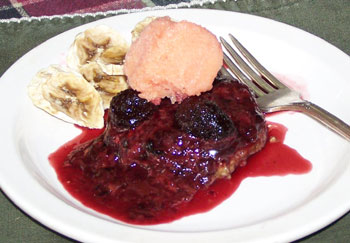
Jim here... Thought I'd post a pic from Wendi's birthday last Friday. Shown above is the "birthday cake" -- more of a birthday treat, really. If it looks decent to you, here's the recipe: The "cake" part: Leaving Sin City, our fearless raw travelers headed south to Arizona for all sorts of raw food adventures. First up was a trip to Prescott Valley to meet Abi and Eli. Let's take a peek into Wendi's travelogue again, shall we
Leaving Las Vegas, she guided us through the Hoover Dam area on our way to Arizona, a geographic area that I think would be better described as a "state of extremes." There, we experienced super hot, sunny days, freezing nights, snow outside even when it's sunny and hot, and also a bizarre experience we had in which some bananas actually froze and then nearly roasted all in the same day. Read more: Arriving At Abi's Arizona Abode After Arduous Attempts
Welcome to Day One of "Dressings Week" here on Pure Jeevan. After finding out that KDcat took it upon herself to film a segment of "Makin' It Monday, Guest Raw Chef Edition," I decided that we should probably spend an entire *week* focusing on salad dressings. Read more: Makin' It Monday Guest Raw Chef Edition: KDcat Makes Orange Pepper Cilantro Dressing |