Know Any Literary Animal Lovers?

Hi there PureJeevan readers! We wanted to let you know that Jim's new novel CHROO is available on Amazon. It's a crazy adventure involving a billionaire heiress, her Chihuahua BFF ("Chroo") and a host of human and animal characters. Find out more on Amazon! Here are some links:
Here's an older post, from August 2008, about modifying one's diet to experiment with attaining even greater health. ?I know the before/after pics, alone, are inspirational enough to live a raw vegan lifestyle!
*blows kisses to everyone*
========================
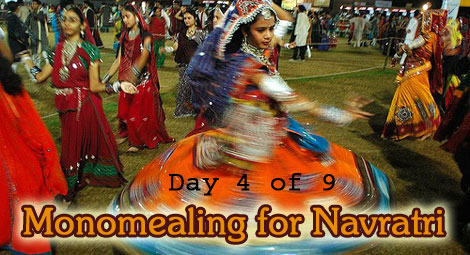
Today is the beginning of the second three-day focus on the attributes of a different Goddess who is most worshiped during the Hindu celebration of Navratri. She is Goddess Lakshmi, bringer of wealth and good luck. Let's focus on the idea of wealth. When we first hear the word, many of us think about monetary wealth. However, there is a much deeper meaning ... that of abundance. Feminine energy has the ability to bring forth, to birth, abundance that is beyond the imagination, in every aspect of our lives. Female energy is fertile, able to create a beautiful life and future, shine forth and bring wisdom into view, all with grace and beauty. All of these are attributes of Goddess Lakshmi, qualities we all have within us. Qualities I celebrate within myself and within all of you (male and female, alike).
 End of Day 3:

Jim here with another installment of Weird Wednesday...
Throughout the year, I go through various phases of fruit preferences. Right now, it's citrus. I eat probably four large grapefruits per day (dark reds). The darker the red the better, IMHO. I can get quite disappointed when the grapefruits are listed as "ruby red" but turn out to be just regular pink ones. I've noticed that the ones I like the most have an orangish tint to them, as though they've been left to ripen on the bush a little too long. Also, the best ones I've had this year have been from Texas. So, find yourself some burnt-looking Texan grapefruits & enjoy the blood-red bitter-sweetness!
Read more: If Oranges Smell So Darned Good to You... Buy Some!

Today we welcome Melissa Sokulski from BirchCenter.com and FoodUnderFoot.com for another episode of Pure Jeevan's Makin' It Monday "Guest Raw Chef" edition. In this episode, Melissa demonstrates how to make raw tortillas (this recipe uses a dehydrator). You'll be amazed at how pliable these tortillas are!!
Read more: Melissa Makes Raw Tortillas on Makin' It Monday "Guest Raw Chef" Edition

Sometimes you meet someone and you just know they have tapped into something special, something most of us search for but never quite find. That was the case when I met this lovely woman I'd like the rest of you to meet. There's a centered peace about her, down deep in her core, and yet she's overflowing with an energy that I've never seen matched by anyone else. She's delightfully insightful, intelligent, and playful all at the same time. ?
Take the Time to Meet

 EVERYONE LOVES RAW TACOS!!! So, this week, we're going to show you FOUR "Makin' It Monday" videos instead of just one. These were filmed in Berkeley, CA, at our dear friend Carolyn's apartment. We hope you love these recipes. We actually eat raw tacos quite regularly -- especially when tomatoes are in season.
***** DISCLAIMER: As with all of our posts here at Pure Jeevan, and particularly those coming up over the next week and a half (which will all be tagged with a new term, "Nadi Balance"), please refer to the disclaimer that runs at the bottom of all Pure Jeevan Pages. Wendi and Jim are health researchers, educators, and extreme self-experimenters. ******

Nadi Balance: Part IV...

Jim here... Just a brief, fun post for the weekend... We just saw the movie Scott Pilgrim vs. the World a few days ago. ?It's a great movie, for many reasons. But, vegans will get a real kick out of one scene involving a character named Todd Ingram, who has super powers. ?Why? ?... Because he's a vegan! ?We won't spoil the scene, though. But, if you're a vegan, or know a lot of vegans, you should get a pretty good laugh from this! I think they nearly had to throw Wendi and me out of the theater, as we were laughing so hard (especially Wendi). ?Enjoy. :-)
This past weekend we had the pleasure of Rhio and her partner, Leigh, visiting with us. Rhio was in town for a presentation on Genetically Engineered foods (more about that here) and she took the opportunity to spend some time with us. It was a lovely weekend and we talked about all kinds of things (yes, even non-raw food things!), laughed a lot, enjoyed delicious raw foods, and got to know each other better.
While they were here, Rhio and Leigh agreed to allow us to interview each of them for this blog. Since we needed to keep the interview under ten minutes (the maximum time allowed on most video sites), we decided to ask questions about topics we had already touched on with Rhio and Leigh during their stay--things we thought might be interesting for all of you to hear about.


When we found out that there was a raw foods restaurant in Key West, we knew we'd visit for sure. So, after a wonderful lunch of some of their raw staples (raw tacos and peanut noodles), it was no surprise to us that we found ourselves drifting back toward Help Yourself after the sunset celebration at Mallory Square (the main nightly Key West sunset viewing celebration). When we arrived, we asked to interview the owner, Charlie Wilson. She'd just left after working a very long day at the restaurant. But, an emplyee called her anyway and she graciously agreed to come talk with us! So, here's a bit of that conversation:
Read more: The Key West Raw Scene: Pure Jeevan Gets Up-Close and Personal with Charlie Wilson!
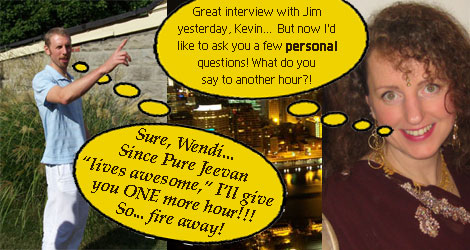
So, did you like Part One yesterday ? Pretty great, right ? Well, today we present Part Two, in which Wendi takes the interview into a more up-close and personal place. In this audio, Kevin shares details about:
-
the first interview he ever conducted
-
what he wanted to be when he grew up
-
what his family thinks of his raw lifestyle
-
his tattoo, Joseph Campbell, and thoughts on life and death
-
spirituality, religion, and guilt
-
the book that opened his mind to a deeper connection
-
running and spirituality
-
his typical day / routine
-
his business expanding
-
what "systems" are and how he uses them
-
the shocking truth about his teen years
-
recent personal development programs he's listening to
-
"taking 1%, applying it, and moving on"
-
mentors and influences
-
the books that shaped his life
-
making shifts in friendships
-
his thoughts on "The Secret"
-
whether he thinks he can do more push-ups than Gabriel Cousens
-
why there was a donkey at his wedding
-
his biggest wish (it's a beautiful one!)
So, what are you waiting for ? Listen NOW!!
Read more: Part *2* of a 3-Part Series Profiling the Multi-Talented Kevin Gianni!