Know Any Literary Animal Lovers?

Hi there PureJeevan readers! We wanted to let you know that Jim's new novel CHROO is available on Amazon. It's a crazy adventure involving a billionaire heiress, her Chihuahua BFF ("Chroo") and a host of human and animal characters. Find out more on Amazon! Here are some links:


On this beautiful May Day, I am thankful for creativity. We all have a creative ability within ourselves to imagine all kinds of things.In yesterday's post, about asking myself questions in order to make changes in my life, I talked about having an image in my mind of how I wanted my life to be in the near future. I was using my creative abilities to see my future as happy, vibrant, and healthy.

Wow, is it Friday already !? Time flies when you're powered by 100% raw organic goodness! Today, we wanted to share an audio interview with you. Last night, Alex Ortner from the Movement to Reverse Diabetes Naturally interviewed us about our recent work helping them spread their message. We were honored to hear him introduce us as "two people that hold a special place in my heart right now, and I'll tell you why that is: They are probably the two most active people that we've had in the movement to reverse diabetes naturally."
Well, Alex, it was our pleasure! We met scores of new people during our work for RDN, generated major awareness about the movement, and spread the word about the raw food lifestyle as well. To listen to or download the interview, just visit their site, here. Topics covered include:
All this week we're continuing to feature a variety of answers to the question "Are Raw Foodists Crazy" from various friends of Pure Jeevan. If you're just now tuning in, please read the back story and introduction to this, as posted on Monday.But, for now, let's continue with posting more of the excellent responses sent in! Enjoy!! :-)

Isn't it high time we incorporate more Internet phenomena into our daily lives? Okay, maybe not everything (reminding myself that certain others aren't always amused when I say "BRB" instead of "I'll be right back.") But, I really do think there are some conceptual web ideas out there that could benefit us if applied more often.
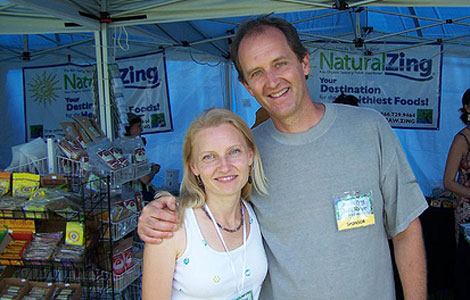
... just a quick interruption of "Crazy Week" to do two things:
1. Congratulate Natural Zing on their 8th year in business!


This weekend is all about having fun! We'll be working on the menu for the upcoming 3-Day Raw Food Spiritual Ashram Retreat that I've organized for the end of May. What does it mean to work on the menu? Well, it means I'll be making and sampling all kinds of gourmet raw food dishes this weekend!
After leaving the windy area of Prescott Valley, AZ, Wendi and KDcat headed up to Sedona. Today is part one of their Sedona visit, focusing on their visit with raw chocolatier, Kelly Johnson. We'll pick up with Wendi's travelogue, where we last left off:
It was great driving to Sedona, since I have a fond place in my heart for this magical spot. I'll talk more about that later, though. When we arrived, went directly to a raw restaurant I remembered visiting a few years ago. The name had changed, and there was a lot more going on there.
KDcat and I placed an order for some food to go (we wanted to have a picnic, rather than be inside when there was so much beauty around), and then met the lovely Kelly Johnson. Kelly is one of the owners of the raw restaurant and he agreed to do a quick interview to tell us about the restaurant and what had changed since the last time I was in Sedona.

End of day 4:
Yesterday I decided to go ahead and consume what my body was telling me it wanted: cooked, fermented rice and lentil pancakes. Well, the restaurant nearby that makes the Uthappam doesn't serve them until 5pm and it was lunch time. So, I ordered the simpler, steamed, fermented rice and lentil patties called Idli.

Here it is...the Queen of all Juices! It's cooling, cleansing, light, easy, delicious, pretty, promotes weight loss, energizing, vibrant, and FUN!
Can one simple juice really be so wonderful for your body? Yes!! Following is the recipe, as well as some highlights about the ingredients and why it's so great for your body.
Cooling and Cleansing Juice
(Serves 1)4 medium apples

Before we moved to Portland, Oregon, land of all things fresh and organic within walking distance, we had to drive quite a distance to reach the food co-op (the only place that had a good selection of organic produce and other raw food necessities). So, we only went shopping about once a week. It took a lot of trial and error to find ways to keep our weekly produce fresh for about a week.
We learned which fruits and vegetables stay fresh the longest, and which go bad the fastest. Based on this, we stocked the refrigerator accordingly (and used up the produce accordingly, as well). The fruits and veggies that stayed fresh the longest were stored in the backs of the shelves (things like carrots, beets, broccoli, cauliflower, apples, etc.). Next we stored the greens that lasted a pretty good amount of time (like kale and collards). And in the front of the shelves and in the door, we stored the more delicate greens (like lettuces and herbs).

As Pure Jeevan blog readers probably know, we're big fans of running ongoing series. A good blog can never have too many, really. So today we mark the official kick-off of another super series. We're calling these articles "Pure Jeevan Guides."
Guides to what , you may ask. Well, to various topics of interest to raw foodies, of course!