Know Any Literary Animal Lovers?

Hi there PureJeevan readers! We wanted to let you know that Jim's new novel CHROO is available on Amazon. It's a crazy adventure involving a billionaire heiress, her Chihuahua BFF ("Chroo") and a host of human and animal characters. Find out more on Amazon! Here are some links:
Wow, what a stressful weekend! We spent pretty much the entire past two days going through the dozens and dozens of suggestions we received in response to our July 30 post concerning our move (in which we asked for help in finding the perfect new place to live). We listed every city suggested to us, as well as a number of cities we specifically wanted to consider. Then we attempted to gather data from the Internet to rank these cities. Here's a HUGE snapshot to show our progress. (I'll explain a few things below.)
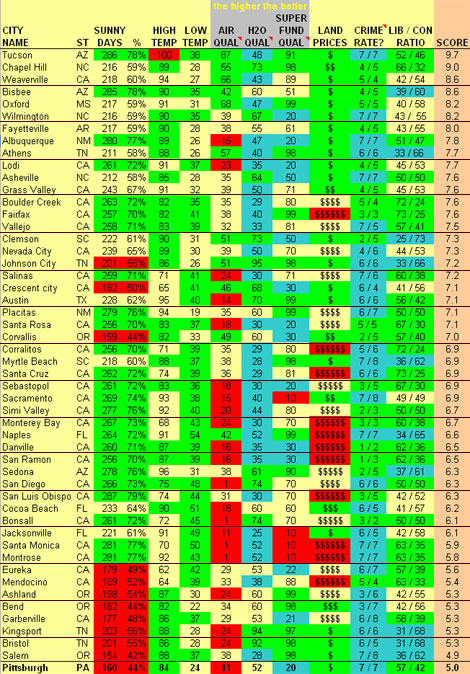
As you can see, we ranked each city according to many criteria. These included the number of sunny days per year, average high and low temperatures, air quality (higher #s better), water quality (higher #s better), Superfund statistics (an indication of the general toxicity of an area -- higher #s better), land prices, crime rate (the numbers "x / x" indicating scores from 1 to 10, lower #s being better, for "personal" crimes and "property" crimes), and finally a "liberal / conservative" ratio based on voting records for that town.

There's a peculiar yet recurring kind of argument I get from a number of people from time to time when the subject of diet or health arises. Basically, it goes like this: "Yeah, all of those vegetables and exercise might be good for you, and all of that meat and fried food I eat might be bad for me, but what if you get hit by a truck tomorrow "
This sort of perspective is interesting to me for at least two major reasons.

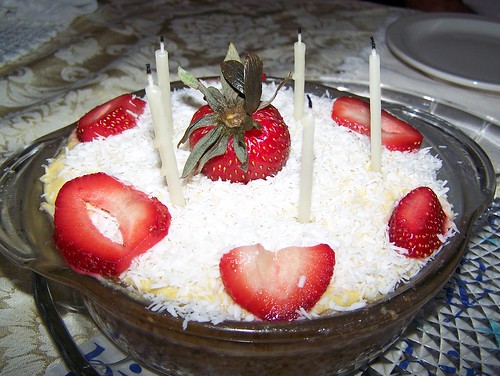
What better way to start our Fun-Filled Friday than by celebrating Jim's birthday ! He worked for half the day and now he's home for a long weekend. So far we've had a nice lunch (cashew/macadamia cheese with red peppers and celery) and birthday pie (mango and pineapple!) after singing "Happy Birthday" to him! This evening we'll have veggie stir-not-fry, since that's what Jim has requested. I prepared it earlier and it's in the dehydrator to marinade and get a bit warm.
You thought our "Know Your Food" series was dead ?!!? (Or, if you're a new reader, maybe you don't know what "Know Your Food" is yet!) Well, we've been poking around in the archives this week and discovered THREE lost episodes. This is HUGE... It's like one of those stories you hear every few years about some rare Hollywood film being discovered in a vault somewhere (laughing so hard)!
Over the next week or two, we'll be posting these three episodes. Today's episode is PUMPKIN, starring Wendi and her guest Ella (daughter of Melissa and Dave, who run the FoodUnderFoot blog we linked to recently). Once these missing episodes have been aired, this will usher in the dawn of a never-before seen level of production values for the Know Your Food series. The new stuff will totally win every major award available to YouTubers (continues laughing...).
Sure, we know pumpkins aren't in season right now. However, this video is sweet because of our special guest. So, enjoy the Pumpkin episode:
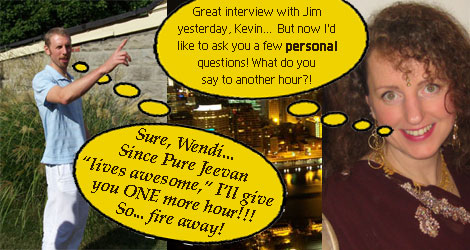
So, did you like Part One yesterday ? Pretty great, right ? Well, today we present Part Two, in which Wendi takes the interview into a more up-close and personal place. In this audio, Kevin shares details about:
-
the first interview he ever conducted
-
what he wanted to be when he grew up
-
what his family thinks of his raw lifestyle
-
his tattoo, Joseph Campbell, and thoughts on life and death
-
spirituality, religion, and guilt
-
the book that opened his mind to a deeper connection
-
running and spirituality
-
his typical day / routine
-
his business expanding
-
what "systems" are and how he uses them
-
the shocking truth about his teen years
-
recent personal development programs he's listening to
-
"taking 1%, applying it, and moving on"
-
mentors and influences
-
the books that shaped his life
-
making shifts in friendships
-
his thoughts on "The Secret"
-
whether he thinks he can do more push-ups than Gabriel Cousens
-
why there was a donkey at his wedding
-
his biggest wish (it's a beautiful one!)
So, what are you waiting for ? Listen NOW!!
Read more: Part *2* of a 3-Part Series Profiling the Multi-Talented Kevin Gianni!

Here it is...the Queen of all Juices! It's cooling, cleansing, light, easy, delicious, pretty, promotes weight loss, energizing, vibrant, and FUN!
Can one simple juice really be so wonderful for your body? Yes!! Following is the recipe, as well as some highlights about the ingredients and why it's so great for your body.
Cooling and Cleansing Juice
(Serves 1)4 medium apples

In a previous Take the Time Tuesday entry, we introduced you to three fantastic raw food snack companies who have offered to donate samples of their products for our upcoming retreat. If you haven't heard about the 3-Day Raw Food Spiritual Retreat, yet, there is still some space for you to join us from May 23-25, 2008! We ve set this retreat up so that it s as affordable as possible. There s a significant savings if you sign up early, too, so be sure to check it out!
Each individual attending the retreat will receive a gift basket filled with delicious raw food treats from some truly fantastic companies. Keep an eye on the retreat page to see other companies that will be sharing delicious raw food snacks with those attending the retreat! Today, we'd like you to...
Today, for Makin' It Monday, Jim has taken you through the steps of making a vegetable wrap. He came home for lunch, pulled the veggies out of the fridge, and the filming began. He quickly shows how just about anyone can prepare fresh, raw, delicious food in less than fifteen minutes. His goal was to get it done in under ten minutes, but it actually took about fourteen. Still, fourteen minutes to prepare amazingly tasty, delicious, and nutritious food is AWESOME!
Today we welcome Melissa Sokulski from BirchCenter.com and FoodUnderFoot.com for another episode of Pure Jeevan's Makin' It Monday "Guest Raw Chef" edition. In this episode, Melissa demonstrates how to make raw tortillas (this recipe uses a dehydrator). You'll be amazed at how pliable these tortillas are!!
Read more: Melissa Makes Raw Tortillas on Makin' It Monday "Guest Raw Chef" Edition

Today we're running another installment of our "Thankful Thursday" series. This time, we're especially thankful ... for YOU, the Pure Jeevan family! Who'd have thought, less than two years ago when launching this blog, that we'd make thousands of connections with others looking for inspiration on their raw food journey !!? It's simply astounding -- and we're still actually "just getting started."
As always, we're thrilled to provide information and inspiration. It's counter-intuitive, when you really consider it; "raw foods" may be just two simple words, yet there always seems to be more and more to talk about, more people to interview, more success stories to highlight, more recipes to contribute, more tips and tricks to share, more personal reflections to offer.
Read more: Thankful Thursday: Pure Jeevan Asks for Your Help!
I want to admit something to all of you: Sometimes I still cry because of how people treated me when I was obese. Because I stuffed all of my "negative" emotions deep inside my entire life, it's going to take some time to fully release them. I'm working on it, however, and making tremendous progress with healing myself on all levels. I'm not telling you these things so you'll feel sorry for me, however. I'm telling you because I am thankful for all the pain I endured. It shaped me (in more ways than just my physical appearance) into the person I am today.
Even though it sounds strange, and somehow wrong to feel this way, I'm thankful that I was obese. I'm thankful for all of the experiences during my life, even the extremely painful, traumatic ones. Maybe if I was a different kind of person I would wish that those things didn't happen to me. However, I am using those experiences in positive ways. They've helped me understand people even better, and to understand myself on a deeper level, as well. When people reach out to me it's not only because I'm an approachable person, it's because they sense that I understand them--and they're right. I DO understand them. I understand you. My experiences, coupled with my gift of empathy, help me relate to you in a way that maybe not everyone else is able to do.