Know Any Literary Animal Lovers?

Hi there PureJeevan readers! We wanted to let you know that Jim's new novel CHROO is available on Amazon. It's a crazy adventure involving a billionaire heiress, her Chihuahua BFF ("Chroo") and a host of human and animal characters. Find out more on Amazon! Here are some links:
Here's an older post, from August 2008, about modifying one's diet to experiment with attaining even greater health. ?I know the before/after pics, alone, are inspirational enough to live a raw vegan lifestyle!
*blows kisses to everyone*
========================
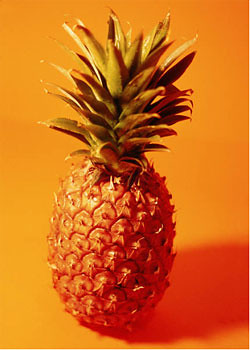
Eating only mono meals is going pretty well. I'm on my third food, so far, and have ended day two. This evening I've started my third fruit: Pineapples!
There's SO much to celebrate lately! Check it out:
 Our dear friend Robin (aka Rawbin) celebrates her birthday today. We created a fun video for Rawbin, who has the ability to make anyone laugh! Rawbin blogs here and you can read her "My Raw Story" installment here.She's also the east coast Raw Spirit Festival representative. (RSF east happens August 29-30, 2009 in Maryland. More info here.)

Last night I dreamed of meandering through an unfamiliar cityscape, following some lonely sidewalk next to a river at night, feeling particularly sad and miserable beneath dim yellow street lights. I wore a black suit, carried a highball glass, and was absolutely drunk!
Having crossed the river, I soon realized (even in my dream-drunken state) that I'd been wandering aimlessly. Feeling rather pathetic, I decided to walk back across the river and sober up in a casino that I knew was there. Drunk and depressed, I figured I'd just sit in front of a slot machine for a few hours.
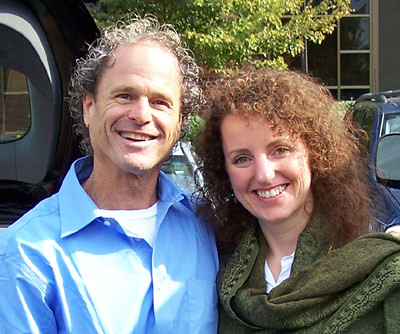
I met Dr. Doug Graham in person at the Raw Spirit Festival. He has a soft, gentle voice but his message is anything but soft. He's straight-forward about diet and health being intimately related. Dr. D. invited me to be his guest this past Saturday at a doctors' convention where he boldly stated to his audience of doctors: "I'm probably not going to make you all that happy with the things I'm going to tell you."
There he was, standing in front of a room of doctors who have taken an oath to harm none. These doctors were there to learn about health and nutrition, but I don't think they had any idea about what they were going to learn from Dr. D. "What I say may fly in the face of what you've been taught," Dr. D. admitted. Many of the doctors leaned forward a bit, eyes and ears a bit more open at the thought of hearing something radical.
... just a quick interruption of "Crazy Week" to do two things:
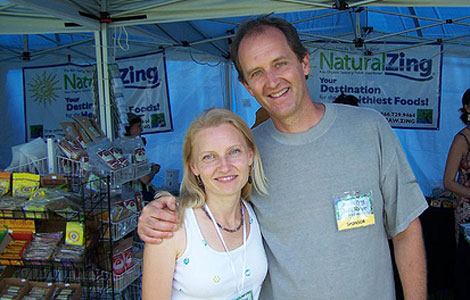
1. Congratulate Natural Zing on their 8th year in business!
Jim here... I have about 3 free minutes this afternoon to post here, so please bear with me as I type this post as fast as humanly possible. Okay, here's a fascinating video we shot last night. For anyone unfamiliar with live blood cell analysis, definitely check out this video. What they do is take a small drop of your blood (via a painless finger prick) and magnify it like 80 kajillion times. Then, they show you a real-time picture of what's going on in your blood.
Two main points from this:?
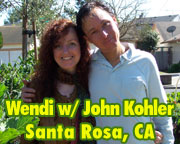 As we promised yesterday, we're featuring a wonderful (and LONG!) video interview today with the incredible John Kohler of Santa Rosa, CA. You may be familiar with John from some of his popular web sites, most notably his "Living and Raw Foods" community site at www.RawFoods.com. Below are parts one, two, and three of Wendi's interview. They're roughly 10 minutes each. (That's a lot of time, I realize, but at least check out Part 1 if you're short on time, as it offers an amazing look at John's front yard.)
Wendi said she was at a loss for words when interviewing John at his home (and you'll soon see why!), because what he has done on his 1/10th of an acre lot is *phenomenal*. He told Wendi off the video that it's all a matter of trial and error--finding what grows easily and well, and working with those plants the most. If something takes a lot of effort, or is difficult to easily grown, he skips it and focuses on what can give the most yield for the least work. Almost everything grown on John's land is edible!
PART TWO:
PART THREE:
The video of John's garden and the pictures (see yesterday's post) are enough to inspire ANYONE to plant even a small garden for themselves! WOW!
John has a lot going on, including a monthly potluck. Wendi and KDcat happened to be in town on the night of the March potluck, so Wendi was invited to speak at the event. It was a nice, laid-back group of people, Wendi said, and they sat at a long table talking about the raw lifestyle, health issues / concerns, what children are fed in school, and so much more -- a really nice group of people, Wendi said, noting she'd love to visit them all again. To connect with John Kohler is pretty easy. He's on the internet at:
- RawFoods.com -- John's main community site
- GrowingYourGreens.com -- John's YouTube channel
- BeRaw.com -- Santa Rosa Meetup Group
- RawHealthExpo.com -- Annual Raw Foods Conference
Once again, we d love to thank our generous trip snack sponsor, Natural Zing, for helping us to make this possible on our budget!

Original Comments
Below, we have included the original comments from this blog post. Additional comments may be made via Facebook, below.
On March 19, 2010, wrote:
fantastic, thank you so much Wendi, very informative, what a guy and energy bomb he is, hope you are well again, you seem so
love to you


This weekend is all about having fun! We'll be working on the menu for the upcoming 3-Day Raw Food Spiritual Ashram Retreat that I've organized for the end of May. What does it mean to work on the menu? Well, it means I'll be making and sampling all kinds of gourmet raw food dishes this weekend!
Here's part two of Wendi's travelogue from Sedona:
After leaving ChocolaTree Cafe, and interviewing the lovely Kelly, we went to the famous Sedona Airport vortex spot, but there was no parking, so we drove to the top of the rock/mountain and there was a farmer's market going on. We took a quick video of what was happening up there, to share on the blog. There was a cool musician playing: Vighas Kendzia, who plays piano, native flutes, sax, and more. He's from musicfromthegarden.com and I told him he'd be on our site. So, if you made it here to check out the video, welcome, Vighas! :-)
From there, we headed out to find a vortex spot that Kelly described. I'm not sure if we found the exact spot, but we really enjoyed the place we found. We ate our lunch there and it was DELICIOUS! The water, the trees, the large boulders, the fresh air...it was a very special place. We then drove to one of the more well-known hiking/vortex spots: Bell Rock.The hike in is a bit over a mile, then there is the climbing (which isn't really recommended by the park officials, but it's absolutely necessary to fully experience Sedona!). I gave KDcat some space to explore the area a bit on her own, as this was a very special time for me a few years ago. There is a certain energy and cleansing that happens when visiting Sedona. If any of you are going through changes in your lives, or feel like there is a shift that needs to happen, I highly recommend visiting Sedona for a few days. KDcat felt some powerful personal healing, which didn't surprise me at all. It's a place I'd love to visit every few years, or so, as it definitely holds some sort of healing energy. Maybe it's just the views, or the peacefulness of being away from everything. Whatever it is, I highly recommend visiting Sedona and climbing around on the rocks!
Some of you know about my love of Sedona, AZ, especially those who were following the Pure Jeevan blog a few years ago. It was a visit to Sedona in 2008, for a Raw Spirit Festival, that my life dramatically changed once again. This time it wasn't the food that was healing me, but it was related to the raw food lifestyle. I felt healed on many levels while there in Sedona, surrounded by the beautiful red rocks, cool and sandy earth beneath my bare feet in contrast to the warm sun on my skin, and embraced by a vibrant, loving community of like-minded individuals.
There's a certain magic to Sedona, if you believe in such things (well, I suppose it's there even if you don't believe). ;-) ?For me, I believe that we can many times find scientific reasons to explain much of the magic in this beautiful world, but that doesn't have to diminsh the experiences we have. Sedona is known for its powerful vortex energy, which has a way of stirring up our own energy systems and bringing about healing, balance, awakenings, etc. ?Is this energy measurable through science, or is it more metaphysical in nature? I don't know and to be honest, it doesn't matter to me. There were life-altering changes that took place while I was in Sedona in 2008 which rippled out beyond me and touched the lives of those very close to me, as well.Here's a quick video of a Sedona Farmer's Market and a clip of KDcat and I at an area we claimed to be flowing with vortex energy, even though it wasn't necessarily one of the more touristy vortex destinations.
Read more: Sedona Farmer's Market and Lunch at a Vortex with KDcat

The diets of raw foodists are as varied as those of individuals consuming the Standard American Diet. The majority of raw foodists are either: 1) gourmet raw foodists, who consume dishes that are usually heavy in fat from nuts (Pure Jeevan started out this way); 2) basics raw foodists, who don't process their fruits and veggies in blenders, food processors, or dehydrators; 3) mono raw foodists, who consume single foods for each meal (i.e., a meal of only apples for breakfast, romaine lettuce for lunch); 4) low fat raw foodists, who consume processed meals at times, but prefer to keep their fat intake below 20% of their calories (Pure Jeevan is working toward this); and
Take the time to meet #5 ...