Know Any Literary Animal Lovers?

Hi there PureJeevan readers! We wanted to let you know that Jim's new novel CHROO is available on Amazon. It's a crazy adventure involving a billionaire heiress, her Chihuahua BFF ("Chroo") and a host of human and animal characters. Find out more on Amazon! Here are some links:

Wow, we've been getting a lot of publicity lately.(We'll be writing more about that later.) We're thrilled to be recognized for the work we're doing for the raw food community!
For those newly acquainted with Pure Jeevan, you've already found our blog (this site), and likely our main site. But, we also wanted to highlight another offering we've put a lot of work into -- the All Raw Directory. Here's a screenshot:

Welcome to Pure Jeevan's "Juice-a-Day Jamboree"! You're probably wondering, "What IS Pure Jeevan's Juice-a-Day Jamboree, anyway "? Well, it's simple:? It's an ongoing, informal, loosely organized "event" centered around juicing. Think of it as an interim step between (1) any kind of diet or lifestyle, from SAD to full-on raw, that does not include much regular juice, and (2) an all out juice feast where that's ALL you'd consume for a period of time. Basically, we're saying, "Let's just make this simple and accessible for everyone. Let's just make a goal to simply drink more fresh juice!"
Wendi and I have been thinking a lot about incorporating more juicing into our lives lately (which is something we've done off and on over the years but never stuck with long-term). One thing holding us back from doing it more often is the time requirement. When we juice, it usually takes a half hour or so from start to finish. I know it doesn't seem that complicated, but I suppose it's just the whole process of setting up the juicer, washing and peeling the produce, juicing it, setting the juice aside while we clean the juicer, doling out the juice into glasses, cleaning up the mini-mess that makes, and then sitting down to actually enjoy the juice.
Angela Stokes, well known and loved by many in the Raw Food Community, was interviewed on CNN back in September. The story was so popular that it has been mentioned on CNN, again! So, I'm reposting my original blog entry about the interview, below, for anyone who missed the interview or this blog entry.
Below you can see the interview of Angela Stokes that originally ran on CNN:
Read more: Angela Stokes on CNN: Did A Raw Food Diet REALLY Help Her?
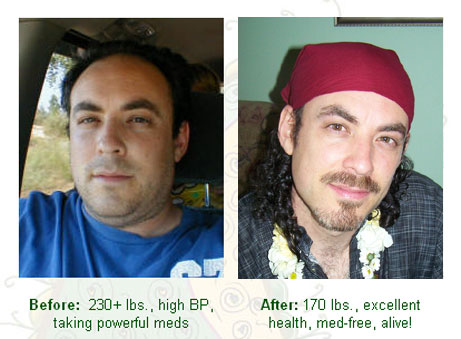
Jim here... Sorry for being away for so long. We've got SO much going on these days, it's mind-boggling! More on that later, as I have something in mind already for today...I should start by clarifying that I've been basically raw for almost 4 years now (high-raw, you might say). During the first nearly-two years, I still ate meat from time to time. Actually, I still ate (and drank) almost everything from time to time -- sugars, processed foods, alcohol, you name it -- only less than I did before, and within the context of a dietary intake consisting of a significantly higher percentage of living foods. In those early years, I'd estimate I was averaging 75-90% raw. Not bad ... I definitely experienced improvements in my health!
 The big change in consciousness didn't follow until two years ago. (This is an interesting point because, as you can see, I wasn't "ready" for a bigger change for two years into eating a lot of raw foods!) I suppose the difference was that, during the early years, I was pretty much raw by default rather than by conscious decision. As Jules said in Pulp Fiction, "... my girlfriend's a vegetarian. ?Which more or less makes me a vegetarian..." Yeah, that was my case back then, too, although I certainly grew into it (and am thankful that I did).
Read more: Reflecting on Two Years of an Exclusively Raw Die
Okay, so here's a recipe that may make you raise an eyebrow. "Baked " "Rice " Well, it's not really baked and there isn't really rice in it, but it tastes like a baked rice and veggies dish! I created this one day by mistake and we all loved it.
Baked Rice and Veggies
2 cups pureed sunflower seeds

Let's stay sharp by learning about brain power! Did you know that the less exercise your brain receives through reading, learning new things (like you do here on our blog!), playing games, and contemplating puzzles the more it is likely to become weak and not serve you well into your centenarian years? Scientists have been trying to figure out ways to improve the brain's function and have learned a lot, but are still uncertain what causes Alzheimer's Disease, or any other form of Dementia.
If you ve ever known someone who suffers with a loss of mental capabilities, you know how sad and sometimes scary that can be. Last week, Jim posted a blog that touched a bit on the subject of Alzheimer s Disease. He wrote in that article, ?I want better than just a small chance that I ll live healthfully for a full lifespan. I want to stack the aging deck in my favor. ?Eating a healthy, raw food diet is something Jim was hoping to use in order to stack the deck in his favor of a life free of memory loss and full of vibrant health.
Correction: I said "Lenuria" a number of times in this video, but it's actually Lunaria! In any case, we wanted to share some additional description for this plant. Here's a quick paragraph from Wikipedia:
Lunaria is a genus of flowering plants in the family Brassicaceae, native to central and southern Europe. It includes two species, Perennial honesty and Annual honesty. They are widely grown as ornamental plants in gardens, and have become naturalised in many temperate areas away from their native habitat. In the language of flowers, it means Sincerity and Forgetfulness. ...The common name "Honesty" arose in the 16th century, and it may be due to the translucent seed-pods which are like flattened pea-pods and borne on the plant through winter. In South-East Asia, it is called the "Money Plant," and in the United States as "Silver dollars," because its seed pods have the appearance of silver coins.
And here's the conclusion of Wendi's San Francisco travelogue:
 That evening we met up with Carolyn, a long-time friend since college, who was our lovely host for a few days. Carolyn has a gift with cats, which was a real treat for KDcat to see. Do you know how you can teach dogs to sit and give kisses? Well, Carolyn has taught one of her rescued cats to do the same thing! He *really* sits and *really* gives kisses on command! WOW!
Carolyn showed us all around the San Franciso and Berkeley areas, bringing KDcat to a thrift shop (she's been having fun popping into random thrift shops to see what she can find) and a fun shop called Ancient Ways, stopping by some Indian shops so I could pick up some more bindis and some ground coriander for a dish I made while visiting, checking out the Berkeley campus area, and taking us shopping for organic foods.
Read more: Part 4 of 4: Glowing Gypsy Gals Glimpse the Glorious Golden Gate's Gastronomical Goodness
If you've been following us for some time, you'll know that we are continually working on projects that will either serve our raw food community or educate others about the health benefits of a raw food lifestyle. If you are new here, or just getting to know us, you can read a summary of what we accomplished last year and a summary of the projects we're currently working on. We're serious about our goal to inspire others to learn about and embrace the raw food lifestyle and community. I've always been someone who helps others, who senses in what direction they are headed and then offers inspiration to keep them moving. I love the work we do as Pure Jeevan and it is extremely rewarding to receive so much gratitude from many of you. But, guess what? Sometimes I get tired!
Sure, some of you may be saying, "But, wait! People who eat raw foods are supposed to be power houses of energy -- able to continually keep active and never run out of steam." Well, that is very true. So, I take it back. I'm not really "tired" like I said -- my body is able to wake up in the morning, easily fall asleep in the evening, and go about its daily work without feeling like it's run down.However, I am feeling like I need a rest from all that I've been doing. Maybe I don't need to sleep hours and hours, because my body isn't truly tired. None of my being is truly tired -- my body, mind, spirit, and emotions are feeling great, actually.
However, I still feel like I need a break from my routine. On top of that, I've been feeling uncomfortable in the cold weather even more this year than I did last year. It hurts all the way down, deep inside my bones. I feel like it will take a lifetime to thaw from the cold I've been feeling here in Pittsburgh. The sun rarely shines, and the snow and ice are brutal on someone eating only raw foods. My instincts told me two years ago that it was time to move to a warmer, sunnier climate, but that hasn't happened yet (even though we are patiently working on it, as Jim pointed out in an earlier post).

Jim here... About an hour ago, I purchased $68 worth of ice cream from a local supermarket. Bet you thought you'd never read something like that here, eh ? Well, don't worry -- Wendi and I haven't suddenly decided to binge on dairy products. You see, in my corporate job, I'm often the event organizer; today that meant ice cream gopher.
For some raw foodies, that scenario might seem rather cruel. You may be thinking: Isn't it tough to have to go purchase nine tubs of ice cream, two jars of maraschino cherries, two bags of marshmallows, four containers of flavored syrups, two cans of whipped cream, and numerous boxes of waffle cones ? No, it's not cruel at all. To me, it's now the same as running out for, say, office supplies.
I was sitting here today thinking about all of you, our lovely online friends who visit this blog. You follow what's going on with us, learn from us, find inspiration in the things we share, and even offer support to us in many ways.
Some of you reach out by leaving comments, many of you send emails, and a larger majority of you are quiet friends who haven't made contact with us, yet. Each and every one of you means so very much to me (and to Jim, too).
We don't keep this blog for ourselves; we keep it for all of you. It is our desire to share all that we've been through, and what we've learned, in order to help you with your own journey. Most of all, however, my personal desire is to inspire you to live the life you truly want to be living (in more ways than just through what you eat).