Know Any Literary Animal Lovers?

Hi there PureJeevan readers! We wanted to let you know that Jim's new novel CHROO is available on Amazon. It's a crazy adventure involving a billionaire heiress, her Chihuahua BFF ("Chroo") and a host of human and animal characters. Find out more on Amazon! Here are some links:

It's nice to meet new people, isn't it? For today's Take the Time Tuesday, I'd love for you to meet someone who's really helping to make a difference in the raw food world in an exciting way.
Take the time to meet...
EXCITING ANNOUNCEMENT!
Kevin Gianni Wants to Meet
Pittsburgh Raw Foodists This Saturday!
UPDATE: Location is set for my home in the South Hills
Kevin and Annmarie Gianni will be in Pittsburgh for the Steeler's game on Sunday. They'd love to meet Pittsburgh raw foodies while they're here! So, if you can make it to meet up with them, let Wendi Dee know as soon as possible. We'll either be meeting at the East End Food Coop (if I can reserve the space at the last minute) or at my home (South Hills/Brentwood). Please respond by Friday at 5:00 p.m. about your availablity.
 Wow, today is Day 7 of the Big 2010 Tour! So far, Wendi and KDcat have spent three days on a train and three more in Portland, Salem, and Corvallis. We still have plenty of content to post from those, including a good deal of video (once I'm able to edit that). For now, let's look at some pics and talk about their second stop, Salem!
Prior to leaving, Wendi & KDcat (let's just say "W&K" from here on out, okay ) stopped at People's Co-Op in Portland for supplies. As much as they loved Portland, they weren't very impressed with the co-op there, as compared to the one we have in Pittsburgh. However, in fairness, they were told that it's still a "young" co-op. Still, it's surprising to me that Portland wouldn't have an enormous one. However, it could very well be that there is not as much of a need there, in an area in which organics are much more accepted. Here in Pittsburgh, one could argue that our co-op thrives because organics are largely scoffed at by other retailers. Interesting, eh?
(By the way, are people on the west coast really as laid back as everyone says Wendi got into a bit of hot water for filming inside another co-op! Here in Pittsburgh, I doubt anyone would care if you set up a movie set in our co-op. No charges were filed, thankfully.)
Read more: Seeing Salem's Shops, Stores, and Super-cheap Supermarkets Spawns Smiles
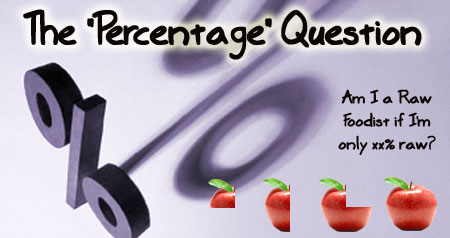
Jim here... "Do I Need to Eat a Certain Percentage of Raw Foods to Call Myself a Raw Foodist " This seems to be a common question among some people interested in pursuing a raw and living foods lifestyle. I fielded such a question recently online, and thought I'd recap my own answer here, somewhat edited for enhanced clarity:
I know what raw foodism means. And, if you're here, you probably do to, or at least you're interested in it and know the basics. But, to the mainstream population, raw is absolutely unheard of, totally out of the box -- relatively speaking. So, let's begin by taking a look at who in the world has potentially heard of RAW. Let's start more broadly and then hone in.
Read more: Do I Need to Eat a Certain Percentage of Raw Foods to Call Myself a Raw Foodist?

It's Fun-Filled Friday again---that week went by so quickly! So, what fun did you have this past week and what fun have you planned for yourself in the near future? It's very important to make the time for fun. We all know that, right? But, how many of us actually carve out the time to have some special fun without stress, without problems---a time when we can laugh and experience the joys of being alive?

Can you believe it's mid-October already ? Here in Pittsburgh, for those lucky few who may have fig trees, that means harvest time! Well, almost. Take a look at this video we made about figs!
As stated in the video, we did a previous installment on figs in our Know Your Food series (which will definitely be returning once we finally sell our home and become full-time raw food inspiration providers!). Please visit that link for nutrition and other information on figs.

"Only somebody who really takes the time to understand [Pure Jeevan's Salsa's*] potential can then coax it into its fullest expression. Then, I mean, oh its flavors, they're just the most haunting and brilliant and thrilling and subtle and ... ancient on the planet." ~ Miles Raymond in "Sideways" (2004) (*slightly modified).
Jim here... Over the weekend, I'd made a string of videos for Pure Jeevan using my handy-dandy new phone. To my great surprise, when I went to post them to YouTube, they all came out sideways! So, I'm sorry, friends... you'll have to endure (if you so choose) a somewhat disorienting video, below. But, hey, at least it reminded me of that wondrous quote from the movie Sideways! I imagine Paul Giamatti describing one of my own recent creations this way -- a sort-of half-raw, yet still very healthy delight that I like to make sometimes.
 My reason for featuring a less than 100% raw recipe is two-fold. First, I'd been discussing transitioning to raw (see yesterday's post). And, adding more raw into your non-raw diet is a great way to transition. I believe that raw sauces are an excellent way to achieve this, as I'll explain in the video. Second, if you do prefer a 100% raw dish, then you can simply replace the beans with something else -- perhaps sprouted beans, or maybe your own invention from the dehydrator.
***** DISCLAIMER: As with all of our posts here at Pure Jeevan, and particularly those tagged with a new term, "Nadi Balance," please refer to the disclaimer that runs at the bottom of all Pure Jeevan pages. Wendi and Jim are health researchers, educators, and extreme self-experimenters, not doctors. ******

There are four parts to blood: red blood cells, white blood cells, platelets, and plasma. Using a specialized microscope, one can easily view these parts of the blood. Red blood cells deliver oxygen to, and carbon dioxide from, the body. White blood cells, also known as leukocytes, help defend the body against disease and anything that they see as unnatural or foreign. Platelets help form clots to prevent bleeding. Plasma, comprised of about 90% water, is the fluid that transports all of the above.
Look at the dinner we had this evening!!!

A bean and rice burrito, taco with all the toppings, tomato and pepper salad, and sweet orange salsa! Yum, yum, yum!!! I'll be posting the pic again and sharing a recipe on Monday.
Correction: I said "Lenuria" a number of times in this video, but it's actually Lunaria! In any case, we wanted to share some additional description for this plant. Here's a quick paragraph from Wikipedia:
Lunaria is a genus of flowering plants in the family Brassicaceae, native to central and southern Europe. It includes two species, Perennial honesty and Annual honesty. They are widely grown as ornamental plants in gardens, and have become naturalised in many temperate areas away from their native habitat. In the language of flowers, it means Sincerity and Forgetfulness. ...The common name "Honesty" arose in the 16th century, and it may be due to the translucent seed-pods which are like flattened pea-pods and borne on the plant through winter. In South-East Asia, it is called the "Money Plant," and in the United States as "Silver dollars," because its seed pods have the appearance of silver coins.
Wow, is it really Episode 3 already? How time flies! Remember way back when we started this informative, informational, nutrition-oriented "Know Your Food" series? Seems like ages ago, doesn't it? (Oh, wait... It WAS ages ago. It's just taken us a while to get up to speed with this video stuff!) Anyway, here's the video, followed by some camera/video editing news -- oh, and of course some highly urgent celery information. (Okay, it isn't really urgent at all; we just needed to add a dash of drama.) So, see what you think. You might even learn a thing or two about our stalky green friend.
Not TOO bad, right? We're getting to our goal of roughly 3-minute episodes. Of course, this is still one of our first attempts, shot last Sunday. We thought it was decent enough to not entitle it "salvaged" as we did the previous installment.