Know Any Literary Animal Lovers?

Hi there PureJeevan readers! We wanted to let you know that Jim's new novel CHROO is available on Amazon. It's a crazy adventure involving a billionaire heiress, her Chihuahua BFF ("Chroo") and a host of human and animal characters. Find out more on Amazon! Here are some links:
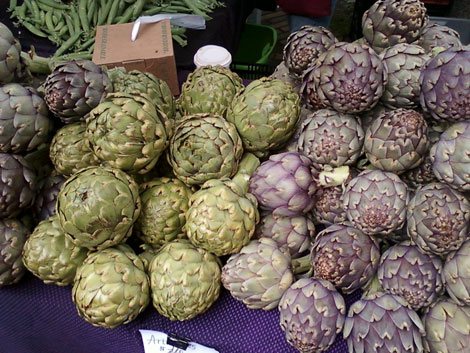
Here's a picture I took at Portland's Saturday Market last week. We've been pleasantly surprised to find that artichokes grow rather well here in the Pacific Northwest. We don't recall seeing them much back East, but many of our neighbors grow them (both for the artichokes and, I suspect, as ornamental plants).
I suspect that some raw foodists tend to overlook artichokes because they're so traditionally linked with the image of something steamed, stuffed with breadcrumbs, and drizzled in butter -- so, "cooked," "breaded," and "dairy" all together in one recipe! Being half Italian, I grew up eating them this way. My mother almost never said "artichoke"; she always called them an Italian word that sounded like "ga-GO-che-lee." ?She made them just a few times per year, and they were always a huge treat (and we'd often fight over the hearts -- by far the best part!).
[caption id="" align="aligncenter" width="500" caption="Perfected Raw Vegan Potato Pancake Recipe!"]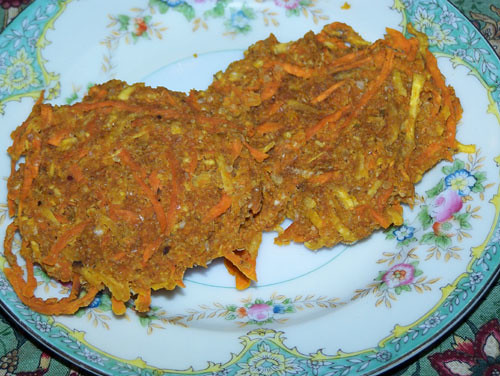 [/caption]
I've done it, I've done it, I've DONE IT!!!? I've perfected a recipe for raw vegan potato pancakes! My friend Melissa shared her potato pancake recipe with me and, like always, I had to play around with it (I rarely go by a set recipe). Had it not been for her original recipe, I wouldn't be writing this post! So, thanks, Melissa!!
In the next day, or two, I'm going to type up the recipe and send it out to all of our subscribers. So, if you haven't signed up recently for either our newsletter or the two free eBooks, do it soon! In addition to the potato pancakes recipe, I'm going to share another amazing recipe I created for Jim's birthday this past weekend: Raw Vegan Ice Cream Cake!! YUM!

Jim here... Back in November of 2010, my friends Joe Prostko, Heather Harris, and I decided to replicate an unusual experiment we'd heard about. Reportedly, some people with health issues had found improvement in their live blood samples after simply grounding themselves for a period of time. We all thought it was interesting enough to try on ourselves, so the above video is the result. ?Since it's 8+ minutes long, I'll spare you any suspense: The results were absolutely inconclusive. (However, we did have fun with it, as you'll see.)
NOTE: The site I'd posted the video on, BlipTV, seems to have gone out of business. Will have to see if I can find the video again and post on youtube.
Read more: Strange Grounding / Blood Experiment -- Inconclusive

I'm makin' nothing today, or for the next eight days! Think of all the time I'm saving myself by consuming only mono meals for nine days. What will I end up doing with that extra time? So far, today, I've spent a long time outside soaking up the sun's beautiful rays that I've missed far too much this Winter. I have no idea what the rest of this mono journey is going to be like, but I'm up for the adventure!
I've started a little journal on my desktop to track my nine days of mono meals, so I'll share what I've written from time-to-time. Here's what I have, so far...

Getting Lyme Disease after regaining my health on the raw foods diet was a tough thing to accept. How could a body cure itself with a raw food diet, yet then fail to even recognize and destroy the Lyme bacteria? So many individuals have recovered from awful diseases, including cancer, by eating a raw food diet. Why, as a raw foodist, has my body been unable to easily eliminate this lyme disease?
I know Jim and I weren't the only ones wondering this. Many of you have voiced concerns, as well. Questions have been asked about how healthy my raw diet has actually been. Have I been cheating and eating cooked foods? Have I been eating too many packaged raw food snacks? Am I drinking alcohol? What have I been doing *wrong* with my diet in order for this to happen in my body? Here are some answers:
Read more: Please Share Immune Building Knowledge with Wendi!
Jim here... Here's part two of a video of Wendi showing how to make raw pasta. (If you did not view part one yet, click here to go there now.) She, with the help of her friend Melissa (of Food Under Foot), prepared a beautiful platter of pastas and some sauces that we all enjoyed when I returned home yesterday for lunch.
We hope this video shows you even more how fun and delicious eating raw foods can be!

Wow, today is a really special day: Jay Kordich's 86th birthday! There must be millions of stories of how Jay has touched the lives of people in enormously positive ways. Here's ours...
Back in the early 1990s when we moved to the Washington, D.C., area, Wendi got a job in Arlington, Virginia. When she walked into work one day, one of the other workers there was absolutely glowing. So, she asked the woman, "Do you have a new boyfriend or something ?!!"

Here it is, the new year. I've never been excited about the end of one year and the beginning of the next, but this time it's different.So many things have changed in our lives here at Pure Jeevan, bringing us to this point in time--a time that we are ready for and fully embrace. This year is going to be RAWmazing!
Many plans and projects have been started over the past few years, and this is the year that will see many of them fully blossom. The beauty of these projects is that they are about so much more than just us, or just you, our lovely readers. Our mission is to help as many people as possible to wake up from a life that's only partially being lived.We believe there are many tools that can be used to fully wake up and embrace life; one of them is eating a raw food diet. We raw foodists know that there is a lot more to life than what we've been taught to believe and expect, and many of us are helping others learn this beautiful fact. We are shaking up many of the core beliefs on which most of us have based our lives. I strongly believe that many of us in the raw food movement can say: We Are The Ones! We are the ones who are here to make positive changes, to help others fully embrace life, and to have fun, fun, fun! Why waste even one more day of your precious life doing something you don't enjoy doing? It's time to have fun, to feel the love that exists within and all around us, and to help others experience the same! So, are you in ?Do you want to join us on this grand adventure of creating a blissful life for not only ourselves, but for the rest of the world, as well?
Read more: Acknowledging Changes and Growth: 2008 / 2009, Part 3

Jim here... We're at an interesting juncture here at Pure Jeevan. For the moment, we're still living a little more "in the box" than we plan to in the near future. One example of this is my personal excitement about Fridays. Oh, I suppose Fridays will always seem special to me somehow. But after years of the corporate routine, Friday remains the most welcome weekday.
Friday signifies the end of the five-day stretch during which most people do whatever they happen to do to pay the bills, to keep (raw!) food on the table, and a roof over their heads. While I know of and admire many people for whom the work week is generally meaningful and rewarding, I suspect that the majority of people go through it simply for the money. Sure, many "like" their job (or, perhaps more aptly, "don't hate it"), but I have met too few who absolutely love their jobs. (Come to think of it, I've met quite a number who actually do hate their work!)
Read more: TGIF!, and a Recap of Major Pure Jeevan Activities
You're in for a treat with this recipe. Our Guest Raw Chef this week is Shivie Kaur, half of "The Cook and Butler" duo of TeamRaw. Wendi shot this video a few weeks back in San Francisco during Pure Jeevan's recent cross-country tour! While there, Shivie and her partner Cemaaj created and served a delicious gourmet meal for Wendi and KDcat. The blog post from that visit was here. So, here's Shivie sharing with you how to make an easy and delicious raw salad dressing!
Read more: Makin' It Monday Guest Raw Chef Edition: Shivie Kaur Makes Salad Dressing
We're heading out of town again! This time we'll be visiting Leela Mata at her Peaceful Valley Ashram, the location of the first raw food spiritual retreat I held last year.
Here's a video I took of Leela Mata last year:
?