Know Any Literary Animal Lovers?

Hi there PureJeevan readers! We wanted to let you know that Jim's new novel CHROO is available on Amazon. It's a crazy adventure involving a billionaire heiress, her Chihuahua BFF ("Chroo") and a host of human and animal characters. Find out more on Amazon! Here are some links:

In a previous Take the Time Tuesday entry, we introduced you to three fantastic raw food snack companies who have offered to donate samples of their products for our upcoming retreat. If you haven't heard about the 3-Day Raw Food Spiritual Retreat, yet, there is still some space for you to join us from May 23-25, 2008! We ve set this retreat up so that it s as affordable as possible. There s a significant savings if you sign up early, too, so be sure to check it out!
Each individual attending the retreat will receive a gift basket filled with delicious raw food treats from some truly fantastic companies. Keep an eye on the retreat page to see other companies that will be sharing delicious raw food snacks with those attending the retreat! Today, we'd like you to...
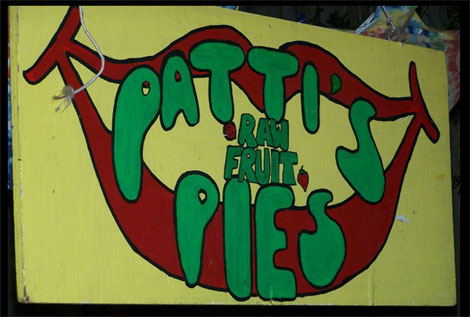
Over the weekend, we visited the spectacular Oregon Country Fair in Eugene and, once again, experienced a joyful and overwhelming sense of recognition that we're living in a place where people are much more accustomed to just being themselves.
Personal expression and nonconformity are so valued here that one becomes quickly enamored of the whole ambiance, which could well explain why more people come to Oregon than leave. The region seems to represent, to many, a chance to finally discover and explore an identity perhaps not completely free from outside influence, but at least free from the undesirable influences that society elsewhere seems to insist upon. Or maybe I'm misreading it all and providing just one of many interpretations.

We're here to inspire you...that's our overall focus here at Pure Jeevan. So, when we ask you what you'd like us to do more of, less of, or to consider doing here on the blog ... we take your responses to heart. Of course, it's impossible to please every single person since we all have different personalities and needs. However, we'll always do our best to create a balance in order to inspire as many individuals as possible.
Below are suggestions for what some of you'd like to see happening here on the blog, along with some responses from us. If you have more suggestions, please send them our way anytime. We read everything that comes in and will always give your suggestions serious consideration.
In some recent Summertime Raw posts, we've focused on preparing delicious, nutritious raw foods *while* on the go. Today, however, we're doing an outing with all of the prep work done at home -- so no need to pack knives and cutting boards! We're also focusing in on a few seasonal ingredients. You'll see some really tasty uses for mint, and we'll also take a look at some wonderful edible flowers. Here's the video:
Read more: Summertime Raw: (Video) Undeniably Magical Sparkling Wonderment!


We now have two more raw food snack companies sharing some of their goodies for the retreat gift baskets! A special thank you go out to:

As this is a holistic web site, it's important that we take time every so often to feature pieces on other aspects of human health besides diet. So, today's subject is unrelated to raw foods, but is directly related to your health. (Don't worry: We'll get back to raw foods on Monday!)
Today I want to share a super-valuable lesson I learned when I was just 21 years old. Back then, Wendi worked within the advertising department of a large newspaper. She helped me meet the paper's photography editor who, in turn, approved an internship for me during my senior year of college. So, several days per week for one semester, I hung out with professional newspaper photographers. It was a lot of fun -- and with real darkrooms, too (as this was way before the age of digital cameras).
Jim here... Okay, the title and graphic, above, may be a bit silly, as are a few of the remarks I made in the video, below. But, within this rather odd piece a few hopefully noble and economical ideas exist -- especially the ridiculously simple and obvious notion about reusing glass beverage bottles. I'm embarrassed to have lived on this planet for so long and not to have adopted this fun and environmentally friendly practice much sooner.
 We really do take things like glass containers for granted, when we probably shouldn't. Their ubiquity aside, it still takes a fair amount of energy and resources to make a single glass bottle. On the mass scale that they're made, they're obviously super cheap. But, if you had to start from scratch, it would take ages to make a single one, so we should at least appreciate them more and do all we can to make their continued existence as sustainable as possible.
Read more: If Keith Richards Is Still Alive, Then Can I Have a Little Tea?
Jim here... I have about 3 free minutes this afternoon to post here, so please bear with me as I type this post as fast as humanly possible. Okay, here's a fascinating video we shot last night. For anyone unfamiliar with live blood cell analysis, definitely check out this video. What they do is take a small drop of your blood (via a painless finger prick) and magnify it like 80 kajillion times. Then, they show you a real-time picture of what's going on in your blood.
Two main points from this:?
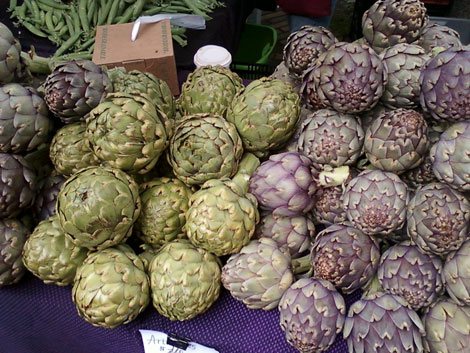
Here's a picture I took at Portland's Saturday Market last week. We've been pleasantly surprised to find that artichokes grow rather well here in the Pacific Northwest. We don't recall seeing them much back East, but many of our neighbors grow them (both for the artichokes and, I suspect, as ornamental plants).
I suspect that some raw foodists tend to overlook artichokes because they're so traditionally linked with the image of something steamed, stuffed with breadcrumbs, and drizzled in butter -- so, "cooked," "breaded," and "dairy" all together in one recipe! Being half Italian, I grew up eating them this way. My mother almost never said "artichoke"; she always called them an Italian word that sounded like "ga-GO-che-lee." ?She made them just a few times per year, and they were always a huge treat (and we'd often fight over the hearts -- by far the best part!).

Yesterday we began a discussion of adding protein powders into your diet (for those who feel that they want or need to do this). One of the easiest ways to get this powder into your body is to add it to your morning smoothie. ?Now, if you're not into the habit of having a morning smoothie, step #1 is to get into that habit. ?(Actually, I don't just "have" morning smoothies; I thoroughly enjoy them!)
Now, you'll notice that smoothies made with protein powder taste quite a bit richer than what you might be used to. So, I want to start with a smoothie that I found to be somewhat light tasting. In fact, I'd even call it "The King" of smoothies. ?:-)
Read more: Protein Powder Smoothies Part 2 of 3: The Blue Hawaii Smoothie

Welcome to Makin' It Monday, Guest Raw Chef edition. Today, Dave Sokulski of www.BirchCenter.com and www.FoodUnderFoot.com gets a little silly while making some delicious raw cacao treats! Enjoy the video: