Know Any Literary Animal Lovers?

Hi there PureJeevan readers! We wanted to let you know that Jim's new novel CHROO is available on Amazon. It's a crazy adventure involving a billionaire heiress, her Chihuahua BFF ("Chroo") and a host of human and animal characters. Find out more on Amazon! Here are some links:

Isn't it amazing how many different, stunningly delicious salad dressings there are in the world ! It's mind-boggling! There could easily be an entire blog devoted to nothing but raw salad dressings -- and I bet, in the right hands, such a blog could go on 5 days / week for literally years before truly exhausting the subject.
 The world simply abounds with good recipe ideas -- and "abundance" is really the mentality you need to embrace when you're doing anything in the culinary world, raw or otherwise. The other side of the spectrum is the "scarcity" perspective, which is when you think, "Oh, I'd love to write a cookboook or create a recipe, but there are already millions of them out there and all of the great culinary creations have been done already."
Note: This entry is not meant for our regular readers. Search engines are directing people to our page when they enter "mono and headaches" and I want to take this opportunity to reach out to those who may not know about this amazing lifestyle the rest of you already know about! ;-) Plus, I want to help them with their headaches.
Mono and Headaches: Looking for Help
Mononucleosis (Mono) is a common viral illness. When children develop mono, it is usually not obvious since it seems like a normal cold. When teens and adults develop mono, however, the symptoms are much more severe. Most individuals will feel better within about three weeks, but fatigue can continue on for about three months! Who wants to feel ill that long? Who wants to feel tired for MONTHS ! Who wants to suffer from such severe headaches ! Not me, that's for sure.

Read more: Mono and Headaches: This Entry is Not For Our Regular Readers

Jim here... Of the many lessons 2008 brought to our household, one standout was certainly the importance of having patience. That s because we set some lofty goals, and lofty goals are often vital teachers.
For example, imagine sitting in your living room one day and deciding: "I'm going to scale Mt. Everest."? (For the purposes of this example, imagine also that no political, administrative, or financial restrictions exist to prevent you from doing this immediately if you really wanted to -- things like passports, entry visas, transportation costs, etc.)
Read more: Acknowledging Changes and Growth: 2008 / 2009, Part 2
This dish is amazing! We've served it to KDcat's friends before and they gobble it right up!
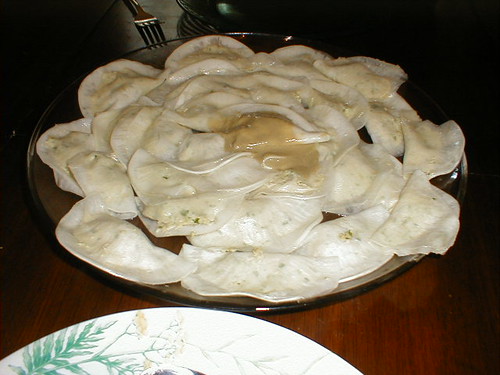
Rawvioli
As promised, here's our interview with Leigh Crizoe, Rhio's partner and co-host of the Hooked on Raw Internet radio program. We think you'll love this interview, as it shows another perspective on raw foods and also gets into an interesting detox program that you may not have heard about. After 9/11, the New York City residents and workers close to ground zero breathed in highly toxic particulate matter for a long span of time. Rhio and Leigh live just blocks from the site, and both experienced respiratory troubles as a result -- especially Leigh, whose sweat began to stain his white t-shirts black! (Yep, you read that right: You'd actually sweat black! This happened to many ground zero workers, in fact.)
Who had the detox answer for them ?... Would you believe L. Ron Hubbard and Tom Cruise ? Apparently, detoxification was an area of high interest to Hubbard, the founder of scientology, who developed an intense regimen of saunas, vitamin supplements, and oils, all specifically for the purpose of ridding the body of toxins. According to Leigh, Tom Cruise personally funded and co-founded the New York program (which has proven highly successful!) after 9/11. (The official site for that detox program is here.)? Super-interesting stuff -- be sure to watch the video.

We tried it in the past, this most unusual fruit. While in Chicago recently, we decided to give it one more try! You see, the first time we tried it we were ... let's just say "not big fans" of the infamous durian. (Here's an episode of Kevin Gianni's Renegade Health Show, shot in our home, documenting that day.) It's a stinky fruit to most, although some claim to enjoy the bizarre odor (which is sometimes described as dirty sock and propane gas smell). If you can get past the smell to give it a taste, you'll be greeted by a taste as strange as the odor. Wendi describes it as a sweet onion pierogie, but each person seems to have a different opinion about this odd fruit.
In this current video our raw friend Debbie Gedayloo-Bennett, whom we met in Chicago, jumped at the opportunity to hang out for a bit of a durian experience. Debbie is on the pro-durian side of the fence that divides those who love and those who hate the alien-like fruit. Wendi was still sitting on the fence, not making up her mind after the initial taste with Kevin and Annmarie. Jim was adamantly sitting far from the love side of the fence, refusing to even attempt approaching the pro side. Debbie was a pro in opening this spiny fruit, so she agreed to open it while on video so that we could share the experience and knowledge with all of you.
Today we thought we'd introduce you to a common wild edible known as Purple Deadnettle (or, more dramatically, the Purple Archangel). Watch the video and let us know if it grows in your area, and if you've tasted it!

Jim here with another exciting installment of Weird Wednesday. (What, you thought that just because Wendi is out of town this week, we'd have no Weird Wednesday )
In any discipline, I think it's important to consider the entire argument in taking a stance on a given issue. Examine each issue from both sides (pro and con) -- and then make the best choice you can. That makes sense, right?
I don't have time to write a real blog post, but wanted to pass along this information for anyone who eats Halloween candy, or knows of others who do. Please note that I am not the kind of person to spread false warnings. I completely trust Mike Adams as a Health Reporter and all around wonderful person. He would not spread false news...he looks into every bit of information available before sharing what he's learned with everyone else.
Mike has issued a warning about Halloween Candy. Please go to his site to find out more about it: NaturalNews.com
?
I'll leave you with an old Halloween picture of me before I started eating raw foods. Halloween used to be the day I'd dress up and feel okay being myself, because I was in costume. It's funny to me that this year I feel no need to cover up in order to be myself. Halloween is still my favorite holiday, however!

Last time on Raw Foods 101 we answered the question, "Why should you soak nuts / seeds before eating them."? Naturally, many readers then asked the next logical question, "How LONG should I soak them before eating " Great question!
Don't forget:? You're soaking the nuts and seeds to "wake them up" as would happen in nature. When seeds are soaked in the springtime rain, they wake up and begin to sprout. When this happens, the nutritional content of the nuts and seeds changes (they become an even greater powerhouse of nutrients).
Read more: Raw Foods 101: How Long Should You Soak Nuts / Seeds Before Eating Them?

There are many things to be thankful for in this life, but for our very first Thankful Thursday entry we'd like to stress how thankful we are for the vibrant health we now have. Consuming only fresh, organic raw fruits, vegetables, nuts and seeds has allowed our bodies to heal from the inside out. For this we will forever be thankful. In fact, we are so thankful that we are here, as Pure Jeevan, to spread the word about how raw, life-filled foods can bring you renewed health!