Know Any Literary Animal Lovers?

Hi there PureJeevan readers! We wanted to let you know that Jim's new novel CHROO is available on Amazon. It's a crazy adventure involving a billionaire heiress, her Chihuahua BFF ("Chroo") and a host of human and animal characters. Find out more on Amazon! Here are some links:

Wow, so much happened in Chicago that it's taking literally weeks to show it all to you!? But, hey, it's also a lot of fun to share this stuff. Wasn't that a great talk yesterday with Kathy and Danny Living !? If you haven't seen it, definitely scroll down and watch!
Here's another one for you. Meet Hatice Yavuz, co-owner along with Chef Mehmet Ak of Cousin's Incredible Vitality, another great raw destination in the Windy City. "Hatice" is a Turkish name, in case you're wondering. The "c" is pronounced like a "j" -- so, her name sounds like "huh-TEE-jay." Our interview with her ran a little long, so I'm going to have to break it into two parts. Here's part one:
Read more: Pure Jeevan Visits Cousin's I.V., Interviews Co-Owner Hatice Yavuz (Part 1)

I know this is our Fun-Filled Friday post, but I have to admit that most of today isn't going to be all that much fun. But, this weekend should be very enjoyable! We have some very special guests arriving tomorrow for a SUPER SPECIAL evening tomorrow night! Leela Mata, a beautiful spiritual teacher, has offered to visit my home and hold Satsang here. One of her extremely talented students, Devaki, will be joining her (and bringing a harmonium to play at Satsang!).


In this special five-part series, Joanna Steven uncovers where some top vegetarian athletes get their protein. Here's part two, focusing on Koya Webb's take on this issue.
ALMONDS
?The greater the percentage of raw food in the diet, the greater the health benefits? is Koya Webb, fitness model, personal trainer, triathlete and body builder's personal motto. Koya's sculpted physique won 1st place in the Ultimate Fitness Events "Fitness Model" and "Bikini Model" competitions and has modeled for Nike, Adidas, New Balance, Muscle and Fitness, Her Sports, Royal Caribbean and Triathlete magazine, to name a few. As a living-foodist (one who eats 60% or more uncooked veggies, nuts, seeds, and super foods) Koya believes eating all natural ?fruits of the earth? can help heal cancer, diabetes, and other diseases plaguing our society today.
Read more: Vegetarian Athletes Share: Top 5 Sources for Animal-free Protein (Part 2 of 5)
Can you believe it's mid-October already ? Here in Pittsburgh, for those lucky few who may have fig trees, that means harvest time! Well, almost. Take a look at this video we made about figs!
As stated in the video, we did a previous installment on figs in our Know Your Food series (which will definitely be returning once we finally sell our home and become full-time raw food inspiration providers!). Please visit that link for nutrition and other information on figs.
 As we promised yesterday, we're featuring a wonderful (and LONG!) video interview today with the incredible John Kohler of Santa Rosa, CA. You may be familiar with John from some of his popular web sites, most notably his "Living and Raw Foods" community site at www.RawFoods.com. Below are parts one, two, and three of Wendi's interview. They're roughly 10 minutes each. (That's a lot of time, I realize, but at least check out Part 1 if you're short on time, as it offers an amazing look at John's front yard.)
Wendi said she was at a loss for words when interviewing John at his home (and you'll soon see why!), because what he has done on his 1/10th of an acre lot is *phenomenal*. He told Wendi off the video that it's all a matter of trial and error--finding what grows easily and well, and working with those plants the most. If something takes a lot of effort, or is difficult to easily grown, he skips it and focuses on what can give the most yield for the least work. Almost everything grown on John's land is edible!
PART TWO:
PART THREE:
The video of John's garden and the pictures (see yesterday's post) are enough to inspire ANYONE to plant even a small garden for themselves! WOW!
John has a lot going on, including a monthly potluck. Wendi and KDcat happened to be in town on the night of the March potluck, so Wendi was invited to speak at the event. It was a nice, laid-back group of people, Wendi said, and they sat at a long table talking about the raw lifestyle, health issues / concerns, what children are fed in school, and so much more -- a really nice group of people, Wendi said, noting she'd love to visit them all again. To connect with John Kohler is pretty easy. He's on the internet at:
- RawFoods.com -- John's main community site
- GrowingYourGreens.com -- John's YouTube channel
- BeRaw.com -- Santa Rosa Meetup Group
- RawHealthExpo.com -- Annual Raw Foods Conference
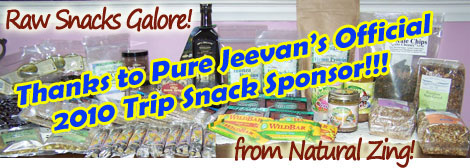
Once again, we d love to thank our generous trip snack sponsor, Natural Zing, for helping us to make this possible on our budget!
Original Comments
Below, we have included the original comments from this blog post. Additional comments may be made via Facebook, below.
On March 19, 2010, wrote:
fantastic, thank you so much Wendi, very informative, what a guy and energy bomb he is, hope you are well again, you seem so
love to you
We're super excited to devote the rest to the week to featuring a variety of answers to the question "Are Raw Foodists Crazy " If you're just now tuning in, please read the back story and introduction to this, as posted yesterday. ?But, for now, let's get on with posting a few responses. We have at least 10 different ones to share this week, from a number of friends of Pure Jeevan. Some are short, humorous quips, others longer essays. Enjoy!! :-)

On August 31st, my project will be finished enough to present it as a
GIFT TO THE ENTIRE RAW COMMUNITY!?
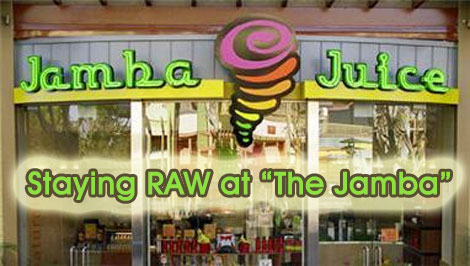
As a follow-up to yesterday's McDonald's-bashing post, I thought I'd post another perspective -- namely, that not all chain smoothies are bad. I can't claim to have tried them all, but I can report with confidence that, for raw most foodists, a trip to Jamba Juice can be awesome!
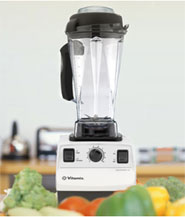 Hey there, everyone! Thanks for visiting Pure Jeevan. We want our welcome article, for now, to be this article on Vitamix blenders. There are certainly a few essential elements (e.g. good knives, cutting boards, a good food processor, etc.) to any raw food kitchen, and one of them is an awesome high-speed blender. Yes, there are many great blenders in the world, and yes there are a few decent top-of-the-line models on par with Vita-Mix. But, at the end of the day, our recommendation is the Vita-Mix (and yes, it's better than Blendtec, in our view). Here's a crazy video Jim did a while back for a Vitamix contest:
Note: That "free shipping" code, below, is no longer active. We'll let you know when we get a new free shipping code. For now, we hope you enjoy the video. :-)
We purchased ours 15+ years ago, and have subjected it to at least daily use (if not many times per day most of the time!) -- and it's still going strong. If you don't understand why a Vita-Mix is different from even a high-end blender from a department store, it's basically the sheer power. These things can pulverize pretty much anything -- time after time, without blowing out the motor. For example, you can make ultra-thick, healthy, raw ice creams day after day all summer long, and the machine will keep on working for years (and, in our case, we're almost ready to say "decades").
We used to be an affiliate w/ them, and are reapplying to be one. For now, we hope you like the video, above.

I'm not sure I'm getting enough carbs 'cuz I eat very little grains or beans and I am always worried of overdoing fruit.
Well, rest assured that if you are consuming enough calories with your diet, and not exclusively eating fats and proteins, you are most likely getting enough carbohydrates. Carbohydrates exist in just about anything you can eat. By simply eating enough food during the day, you can easily meet your body's carbohydrate requirements.
There are two classifications of carbohydrates: simple and complex. Grains and beans fall under the complex category, while fruits fall under the simple category.
Read more: Am I Getting Enough Carbs Without Beans and Grains?
I started writing on a raw food forum about the oranges coming in today. But, I was on my way out the door and I had more to say about them than I realized, so, I figured I'd paste what I wrote, so far, and add to it here in our blog. ;-)
?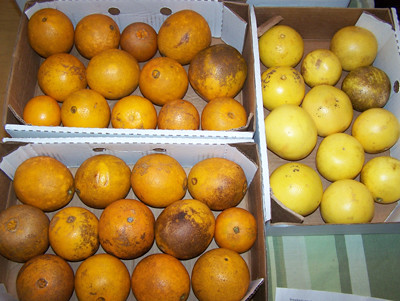
(organic oranges and grapefruits)