Know Any Literary Animal Lovers?

Hi there PureJeevan readers! We wanted to let you know that Jim's new novel CHROO is available on Amazon. It's a crazy adventure involving a billionaire heiress, her Chihuahua BFF ("Chroo") and a host of human and animal characters. Find out more on Amazon! Here are some links:
There's an old saying that "What Happens in Vegas, Stays in Vegas." But we're not ones for keeping secrets. So, here's the low-down on Wendi and KDcat's time in Sin City -- straight from Wendi's travelogue, once again!
 We drove to Las Vegas from California, and loved seeing the change as our surroundings became a desert. The snow-capped mountains are such a beautiful contrast in CA, but especially here in Nevada where it's so dry and hot!
This stop was longer than expected, since we decided to change our schedule a bit in order to get some more relaxing time in--and also to allow KDcat to have some fun that didn't involve raw foods or Pure Jeevan activity. ?We decided to hold off on visiting a date farm and the grand canyon (two activities we'd had planned for this leg of the trip) until Jim could do those things with us as a family. We especially missed him during this part of the trip, because he's always wanted to see what Vegas is like in person.
Read more: Las Vegas, Nevada: Relaxing Times and the Raw Scene at Go Raw Cafe

To help keep all of you inspired, we ve asked some
remarkable individuals to share their raw food stories with you. Enjoy!
With this video, Pure Jeevan concludes coverage of the 2009 Raw Spirit East festival. We started off two Fridays ago covering raw food chefs, then moved on to raw lifestyle speakers and philosophers. The final piece of the gourmet raw pie would have to be the festival ambience, which is somewhat tougher to capture in a short video. But, I think this video does a reasonable job of conveying a lot of the scene "beyond the food." (But even if it doesn't, how many times do you get to see Charles Balcer hula-hooping on video )
Enjoy the video (and pics, below, too)!

If you ve been a Pure Jeevan family member for a while, you know we don t always focus on food in regards to health. Health isn t only about the food you put into your body; it s about so much more. We are mental, spiritual, emotional, physical beings who thrive best when we have a balance in all those areas of our lives. Humans are, for the most part, social beings. If we lack something as vital as social interaction, we become out of balance. As young children, our primary social interaction is through direct contact with our parents and close family members. As we mature, almost all of us develop friendships with individuals outside of our family s social circle. Friendship is essential in helping us maintain a healthy balanced life.
How we meet friends, and how we interact with them, has been changing over the years as online social media communities have been created. For those living a raw food lifestyle and using the Internet to connect with like-minded others, you have no doubt realized there is a strong and growing virtual raw food community online. It s a large tribe, of sorts, where we are able to wander from website to website, meeting others and creating friendships together. (Be sure to join Pure Jeevan s Facebook page to connect with other Pure Jeevan family members.)
in-tu-i-tion n. 1.a. The act or faculty of knowing or sensing without the use of rational processes; immediate cognition. b. Knowledge gained by the use of this faculty; a perceptive insight. 2. A sense of something not evident or deducible; an impression.
FASCINATING!? While out to dinner with our friend Debbie, she brought up the topic of intuitive food preparation. This is really amazing, groundbreaking stuff that probably few people have ever seriously attempted. Now, Wendi has discussed intuitive eating many times here on the blog in the past. Intuitive eating is basically when you get in touch with those "perceptive insights" mentioned above -- a kind of communication with your own body in which you just "know" that you should eat a certain food. Ever, say, walk past a large display of apples and simply know that eating one would make you feel good? That's intuition.
Recently I've been to three potlucks in the span of four days. They've all been wonderful for different reasons -- one was a birthday party for a lovely young woman, Bethany, another was part of a women's circle that my friend, Melissa, invited me to attend, and the other was at my home as a meetup when Kevin and Annmarie Gianni were here visiting. Lots of fun, connecting with people, and raw foods to eat.
Sounds perfect, right? Well, something's been happening with me and raw foods over the past year. It became even more evident after eating at three different potlucks over four days. I've noticed more and more that when I don't eat something that I've created, I many times have reactions to the foods I've eaten. The reactions have ranged from flushed facial skin, slight headaches, hives, full-blown headaches, upset stomach, water retention, achy joints, etc. All signs of being sensitive to something I'm eating, right? I've narrowed it down to a few things, but it doesn't seem to be an exact science to knowing what's going to cause the reaction.
At home I know that I feel better if I don't consume garlic even though I love the taste and smell of it. When I eat too much of it I experience headaches and sometimes flushed cheeks. I gave up raw vinegar a long time ago because it makes my joints ache. Recently I noticed that whenever I eat Nama Shoyu I get a headache, flushed cheeks, and sometimes some hives. So, at home I can control my reactions to foods -- I simply avoid eating the things that sometimes trigger problems for me. I feel great most of the time because I eat more simply and my body doesn't experience any problems.
Read more: Something Has Been Happening With Me and Raw Foods
Ketchup
1 cup sun dried tomatoes, soaked for one hour
3 small fresh tomatoes

Hi everyone!? Sorry for the late post tonight. I had a busy day, and even met with a new realtor to help me sell The Luck House! (Wish us luck on that front -- but I have a super-great feeling that this new realtor is 10x more professional and knowledgeable than the previous one.)
 Today I thought I'd give you a peek into Wendi's rather fascinating Inbox. While she's away, she asked me to monitor her Pure Jeevan mail box and field as many of the questions as possible. It's been ... interesting! :-)? I never realized the volume of email that she receives! It's almost a full-time job to keep on top of it (which I haven't been able to do as well as I'd hoped -- although I now have it down to just a ?hundred or so unanswered ones, so that's progress!).
Mmmmmmmmm! ?I'm sitting here at my computer eating the Best Organic Fuji Apple Ever. Don't believe me? ?Here's a picture of the apple I'm eating right now:
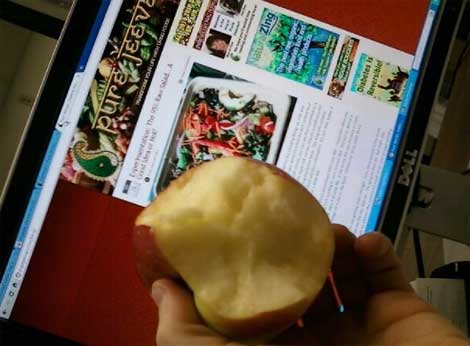
Looks dee-lish, right? ?(Okay, so maybe it's not the most appetizing pic in the world...) ?Anyway, one interesting thing about this apple is that I bought it (a whole big bag of them, actually) because it was so cheap. (I'm on a relatively tight budget these days.) ?But, if it was so cheap, how could it be so tasty? ?(And organic, too!) Well, that's where the basic law of supply and demand come in. Whenever a crop is at the peak of its season, the supply rises considerably. Instead of the store receiving X number of bushels of apples, they receive 5X or more. So, they slash prices to move that kind of volume.
Read more: Delicious Idea for Produce... Putting the Economics of Raw Foods to Work For You!
Thanks to everyone who has offered, so far, to help us out with our project (mentioned in yesterday's post). If anyone else thinks they'd like to help, we're looking for as many people as possible! We'll fill you in soon, just be sure to send us your email addresses if you haven't already done so. Thanks!
Here are more pictures of some of the foods we've been eating. Over the past year, we've pretty much been eating simple foods (except for the time I was preparing meals for the Raw Food Retreat). However, recently KDcat has been doing some extreme yo-yo eating between raw foods and packaged/unhealthy cooked foods. The back and forth has been causing her to experience a bit of a tummy upset. So, I've decided to make our meals a bit more exciting for her---so she'll possibly not feel so tempted by all of the colors and artificial flavors of the packaged "foods" she's been eating.
Talk about color...check out this salad I made earlier today:

What's Valentine's Day without a little "Smooth Love," right ??Here's how we created this simple, creamy delicious, smoothie:
- Start with the water and flesh of one young coconut. We had one left over, still nice and fresh, from our recent trip to the Florida Keys (more raw food videos and posts coming soon from that trip!).
- Add three to four oranges, peeled (and de-seeded if necessary)
- Add two to three large bananas
- Add 12 ounces of frozen strawberries (or to taste)
- Add a small handful of raw almonds
- Add a bit of raw agave nectar or a few dates, if you have them.
Blend in your high-speed blender until smooth ... and share with a loved one! Happy Valentines Day, everyone!