Know Any Literary Animal Lovers?

Hi there PureJeevan readers! We wanted to let you know that Jim's new novel CHROO is available on Amazon. It's a crazy adventure involving a billionaire heiress, her Chihuahua BFF ("Chroo") and a host of human and animal characters. Find out more on Amazon! Here are some links:
Well, here's my latest update on my nine days of mono meal eating. I have a headache this evening and I'm headed to bed early. I'm hoping the headache is a detox symptom and that it will be gone when I wake up.
April 9, 2008
We all know what "greens" are in general. For example, no one questions whether lettuce, kale, spinach, or chard are greens. But on the other hand, all of those items *are* also clearly green in color. With that in mind, what would you make of the following two questions I (Jim) recently pondered -- tagged as "reader questions" so they're easily found in the future by other equally inquisitive people ;-) -- that seem bizarre, but are really quite interesting?
1. Are non-green greens (e.g., purple kale) still considered greens2. Are vegetables with green skins (e.g., cukes, zucchini) considered greens? (After all, they're green!)
With love in my heart, I present this gift to the entire raw and living foods community:
Original Comments
Below, we have included the original comments from this blog post. Additional comments may be made via Facebook, below.

End of day 4:
Yesterday I decided to go ahead and consume what my body was telling me it wanted: cooked, fermented rice and lentil pancakes. Well, the restaurant nearby that makes the Uthappam doesn't serve them until 5pm and it was lunch time. So, I ordered the simpler, steamed, fermented rice and lentil patties called Idli.
Within the raw food community, a controversy seems to have been brewing for the better part of a year! The topic: Agave nectar (also called agave syrup). Surely by now most people know what agave nectar is. For anyone who doesn't, it's a thick liquid sweetener made from, you guessed it, the agave plant.
In general, the production of tasty agave nectar involves heating the plant to a certain temperature (which varies widely according to which manufacturer is making it and which species of agave is used). The extent of this heating constitutes a significant part of the controversy (as most raw foodists believe that heating any food over a certain temperature, usually somewhere between 105 and 118 degrees fahrenheit, renders it "dead").
Read more: Pure Jeevan Explores the Raw Food Community's Agave Nectar Controversy

Every day I receive countless emails filled with questions about the raw food diet, my own success with reducing nearly 100 pounds and regaining health, and pleas for help by many who feel like they've hit bottom and there's no way up. Some emails have me in tears, because I can completely relate to what many of you are going through. I feel your pain, frustration, desperation.
One thing I've always been good at is listening, truly listening to what others are saying (and being an empath allows me to know what some are saying, even when they many times aren't verbalizing it). Another thing I've always been good at is intuitively knowing how to help others who are asking for advice. Jim used to joke that he wanted me to go into business running an advice column because ever since he's known me, I've been the person everyone comes to for help and advice. So, when I receive so many emails asking for help, it feels natural for me to reach out and connect with those needing help. It's what I do best well, that and spreading love!
I received an email from one of our lovely Pure Jeevan family members. Joanne is subscribed to our mailings and she received the ice cream cake recipe I had created for Jim back in January. Well, take a look at what she did with the recipe! It's LOVEly!

Hi Wendi!I took Jim's birthday cake recipe to the next level.

To keep all of you inspired while we are away, we've asked some
remarkable individuals to share their raw food stories with you. Enjoy!

There is a certain irony that takes place when you launch a raw foods web site because, no matter how much you love and believe in what you do, no matter how solid the proof may be that the information you're providing is true and accurate, no matter how clearly it can be demonstrated by analyses of blood tests or tons of "before and after" photos that this lifestyle heals the human body, you're still pretty much bound by legal best practices to include a full disclaimer on your site. And, as much as you just write it once and kind of forget about it, it's always there. For practical reasons, of course we understand all of that. But beyond all of that, there's an implied message that "only a medical doctor" really knows what's best for you.
Well, in fact, we DO recommend working with a competent health professional. But what we do not endorse here is simply accepting whatever that professional has to say without question. So, the operative word would be "competent" in that recommendation.
This pie is amazing and exactly like a traditionally cooked pumpkin pie! I took a few different pie recipes and altered them until I came up with this recipe.
Pumpkin Pie
Filling:
I thought I'd share some recent pictures with all of you. Let me know what you think!?
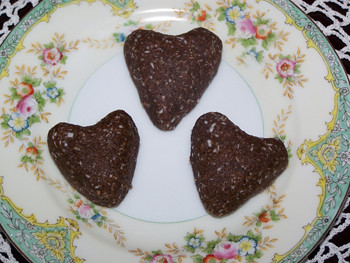
Carob Peppermint Hearts
This is a recipe I created to take the place of a packaged raw cacao dessert that Jim loves. I don't like to eat cacao, because it disturbs my heart, so I use carob. A new raw friend asked for a recipe for this dessert, because she loved it so much, but I don't have one. I dump walnuts, coconut, agave, and peppermint oil into the food processor and mix until it's a consistency that can stick together. For Valentine's Day I shaped the mixture into hearts. Sweet!?