Know Any Literary Animal Lovers?

Hi there PureJeevan readers! We wanted to let you know that Jim's new novel CHROO is available on Amazon. It's a crazy adventure involving a billionaire heiress, her Chihuahua BFF ("Chroo") and a host of human and animal characters. Find out more on Amazon! Here are some links:

To help keep all of you inspired, we ve asked some
remarkable individuals to share their raw food stories with you. Enjoy!

 Continuing with our Taco Week, here's a quick and easy (and delicious) salsa recipe. You can really have a lot of fun with salsa, and can get highly experimental if you like. Almost anything tastes great in salsa. This one is fairly basic, so feel free to spruce it up with some of your favorite ingredients. Let us know in the comments section some of your favorite variations so you may inspire others!

Before we moved to Portland, Oregon, land of all things fresh and organic within walking distance, we had to drive quite a distance to reach the food co-op (the only place that had a good selection of organic produce and other raw food necessities). So, we only went shopping about once a week. It took a lot of trial and error to find ways to keep our weekly produce fresh for about a week.
We learned which fruits and vegetables stay fresh the longest, and which go bad the fastest. Based on this, we stocked the refrigerator accordingly (and used up the produce accordingly, as well). The fruits and veggies that stayed fresh the longest were stored in the backs of the shelves (things like carrots, beets, broccoli, cauliflower, apples, etc.). Next we stored the greens that lasted a pretty good amount of time (like kale and collards). And in the front of the shelves and in the door, we stored the more delicate greens (like lettuces and herbs).

Jim here again... What do you think of that montage of vintage cigarette advertisements ! Knowing what we now know about cigarettes, it's tough to believe that such ads could have existed only 50 years ago, but the campaigns were real. Did doctors actually see no harm in cigarettes? Were there no pulmonary specialists back then who thought that habitually inhaling smoke might not be such a healthy idea Who knows... ?As I like to believe when it comes to doctors, even though they're quite oblivious to the harmful effects that chemicals have on our bodies, they do seem to mean well (in their own deluded ways). So, I don't hold it against them so much as I now hold it against individuals to think for themselves and challenge healthcare practitioners.
In any case, whether or not there is an advertising campaign attached to a new consumer product, it stands to reason that when a product is introduced into the marketplace, manufacturers should have a responsibility to ensure that the product is safe, and consumers should likewise have a reasonable expectation that the product is safe. Only, it doesn't always work that way, does it?
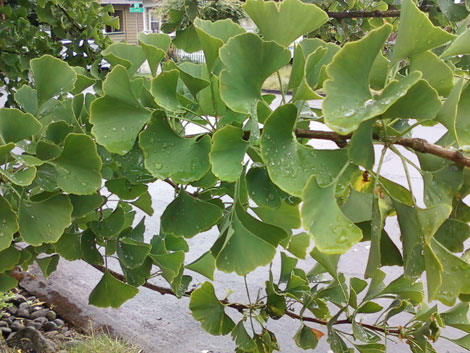
Ahh, yes... Ginkgo Biloba. What a distinctive tree, don't you think? So easy to identify, and so many reported health benefits. This one belongs to a neighbor that seems to have an affinity with Asian landscaping motifs. They also have gorgeous bamboo growing in their yard, and other Asian elements. I would have liked to have harvested some leaves to dry for some Ginkgo tea, but the owner wasn't around to ask. Perhaps some other time.
 As we promised yesterday, we're featuring a wonderful (and LONG!) video interview today with the incredible John Kohler of Santa Rosa, CA. You may be familiar with John from some of his popular web sites, most notably his "Living and Raw Foods" community site at www.RawFoods.com. Below are parts one, two, and three of Wendi's interview. They're roughly 10 minutes each. (That's a lot of time, I realize, but at least check out Part 1 if you're short on time, as it offers an amazing look at John's front yard.)
Wendi said she was at a loss for words when interviewing John at his home (and you'll soon see why!), because what he has done on his 1/10th of an acre lot is *phenomenal*. He told Wendi off the video that it's all a matter of trial and error--finding what grows easily and well, and working with those plants the most. If something takes a lot of effort, or is difficult to easily grown, he skips it and focuses on what can give the most yield for the least work. Almost everything grown on John's land is edible!
PART TWO:
PART THREE:
The video of John's garden and the pictures (see yesterday's post) are enough to inspire ANYONE to plant even a small garden for themselves! WOW!
John has a lot going on, including a monthly potluck. Wendi and KDcat happened to be in town on the night of the March potluck, so Wendi was invited to speak at the event. It was a nice, laid-back group of people, Wendi said, and they sat at a long table talking about the raw lifestyle, health issues / concerns, what children are fed in school, and so much more -- a really nice group of people, Wendi said, noting she'd love to visit them all again. To connect with John Kohler is pretty easy. He's on the internet at:
- RawFoods.com -- John's main community site
- GrowingYourGreens.com -- John's YouTube channel
- BeRaw.com -- Santa Rosa Meetup Group
- RawHealthExpo.com -- Annual Raw Foods Conference
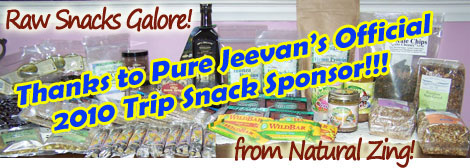
Once again, we d love to thank our generous trip snack sponsor, Natural Zing, for helping us to make this possible on our budget!
Original Comments
Below, we have included the original comments from this blog post. Additional comments may be made via Facebook, below.
On March 19, 2010, wrote:
fantastic, thank you so much Wendi, very informative, what a guy and energy bomb he is, hope you are well again, you seem so
love to you

Here's some coconutty video footage from our Florida Keys excursion. First up is some footage of Randesh, from www.TheGuana.com, who obtains fresh coconuts for Charlie Wilson's Key West restaurant, Help Yourself (see yesterday's blog post).Notice that Randesh uses a proper piece of equipment -- a large machete (or cutlass) -- which makes short, easy work of opening these precious gifts of nature! In the video footage following that, you'll see how comically difficult it is to open a young coconut when you lack the proper equipment. We actually went out looking for a machete, but could only find a large chef's knife at a local K-Mart. Yep, they were sold out of machetes! (Ironically, the chef's knife -- the heaviest one the store had -- cost about $17, while plain old machetes run just $10 or so at most hardware stores. Next time we'll keep looking...)
I was sitting here today thinking about all of you, our lovely online friends who visit this blog. You follow what's going on with us, learn from us, find inspiration in the things we share, and even offer support to us in many ways.
Some of you reach out by leaving comments, many of you send emails, and a larger majority of you are quiet friends who haven't made contact with us, yet. Each and every one of you means so very much to me (and to Jim, too).
We don't keep this blog for ourselves; we keep it for all of you. It is our desire to share all that we've been through, and what we've learned, in order to help you with your own journey. Most of all, however, my personal desire is to inspire you to live the life you truly want to be living (in more ways than just through what you eat).


On this lovely Valentine's Day, I am focusing on how thankful I am for LOVE! I'm not into the whole this-is-the-day-you-are-supposed-to-show-love thing, though. I think love is something that should always be around, felt, and shared. Every day is a new day to express the love you have in so many varied ways, why hold it back for one special day a year?

Something has come up and it may put some of our projects on hold for about six months, or so! What could come up to make us give up our goals/plans for 2009? Umm...how about being awarded The Best Job In The World, the Island Reef Job! Australia is doing some major tourism marketing for their lovely Paradise Island. For six months an individual will live in a 3-bedroom home, comb the beach, blog about the experience, do some video blogging, respond to interviewers, feed fish, and just basically live a life in Paradise!!
To live this dream life, you'll be awarded $105,000 USD and be flown to the island!

At a recent raw food meetup, I was surprised that so many raw foodies aren't aware of the raw almond controversy. Maybe most of our Pure Jeevan family members aren't aware of the fact that most almonds are not raw. It's sad, but very true. In 2006 a mandatory almond pasteurization ruling was created. The rule was passed sometime in 2007, I believe, and since then it's been near impossible to purchase truly raw almonds. Maybe pasteurized almonds don't seem like a big deal to most people.
Raw almonds are alive, yet dormant until they are soaked. Once soaked (or moistened in the springtime rains when outdoors), they sprout to begin growing into almond trees. Once soaked and sprouted, the nutritional content of the nuts change significantly. They are alive and filled with protein and so much more!