Know Any Literary Animal Lovers?

Hi there PureJeevan readers! We wanted to let you know that Jim's new novel CHROO is available on Amazon. It's a crazy adventure involving a billionaire heiress, her Chihuahua BFF ("Chroo") and a host of human and animal characters. Find out more on Amazon! Here are some links:

Thank you, thank you, thank you! Today for Thankful Thursday, we wanted to say a special THANK YOU to our readers. It means so much to us that you come to visit our blog. With every new comment (both here on the blog and through email) it fills us with great happiness!
Is there something you'd like to see more of here on our blog? Something you'd like us to discuss? We know you are looking for more recipes, since you've told us (be sure to check out our recent posts where we've linked to some fantastic sites offering recipes!). What else would you like to read about or have us share with you?

Today I'd like to do something different for Makin' It Monday. I'll tell you what we've eaten today, but I want to hear what's been happening in YOUR kitchen!
This morning I sliced up three bananas, drizzled them with some agave, sprinked a bit of Himalayan crystal salt on them, and then topped them with hemp seeds and sprouted flax seeds with cranberries and gogi berries. I love this breakfast because it feels like I'm eating something a bit complex and more filling than simply eating the bananas plain (which is how I almost always eat them). KDcat had a bowl of oatmeal (not raw), and Jim had a few pieces of fruit.
Read more: Makin' It Monday: What's Happening In YOUR Kitchen?

In our Mnemonics for the ?Clean 15? ? Or, ?Conventional? Produce That Tests Lowest for Residual Pesticides blog post last week, we put an asterisk next to "sweet corn" and took it off our list of foods to eat. Even though sweet corn tests relatively low for pesticides, Pure Jeevan still feels the vegetable isn't a safe choice for a healthy diet. There are primarily two reasons for our decision to completely remove corn from our diets. First, of all the vegetables that have undergone genetic modification (GM), GM corn is one that has been proven to cross-pollinate with non-GM corn. Second, since corn is so plentiful and easy to grow, it has been modified to become all sorts of flavors, sweeteners, fillers, etc., in food products and many individuals have developed sensitivities to it.
Read more: Is Corn Safe to Eat? No, and Neither is Most Papaya!
I like this "travelogue" format, so let's continue! Here's Wendi's comments from their adventures in San Luis Obispo, checking out the raw vibes along the CA Central Coast!
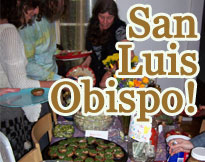 After a very active visit in the San Francisco / Berkeley area, we headed down the coast to San Luis Obispo, CA. There's a pretty active raw food meetup there and we were asked to stop in their town to give a talk to their group.
It was a nice drive south, but the sun is a bit brighter than we're used to (especially when driving long distances). When we arrived in the town, we were overcome by the beauty of the place. It's one of the most beautiful places we've seen in California, so far!
Read more: The Friendly, Mellow, Raw Groove of San Luis Obispo
There's an old saying that "What Happens in Vegas, Stays in Vegas." But we're not ones for keeping secrets. So, here's the low-down on Wendi and KDcat's time in Sin City -- straight from Wendi's travelogue, once again!
 We drove to Las Vegas from California, and loved seeing the change as our surroundings became a desert. The snow-capped mountains are such a beautiful contrast in CA, but especially here in Nevada where it's so dry and hot!
This stop was longer than expected, since we decided to change our schedule a bit in order to get some more relaxing time in--and also to allow KDcat to have some fun that didn't involve raw foods or Pure Jeevan activity. ?We decided to hold off on visiting a date farm and the grand canyon (two activities we'd had planned for this leg of the trip) until Jim could do those things with us as a family. We especially missed him during this part of the trip, because he's always wanted to see what Vegas is like in person.
Read more: Las Vegas, Nevada: Relaxing Times and the Raw Scene at Go Raw Cafe

I hear the question all the time: "Don't you miss eating out at restaurants " My answer is always, "No. I prefer the fresher organic foods I can create for myself in my own home. I can pay the same amount for better food if I stay at home to eat." It's true, too. I don't miss eating out at restaurants. Sometimes I miss the convenience of someone else doing my food prep and cleaning up afterward, but as far as the actual food that I consume, I prefer the foods we eat at home. Besides, when you eat out as a raw foodist, your choices are limited to only a salad if you live in an area with no raw food restaurants.
Sometime last year, as a treat for Jim, we went to a restaurant. I got a huge salad that I used to love when I ate cooked foods at that particular restaurant. I remembered the greens were always dark, the onions were nice and flavorful, and the dressing was a simple oil and vinegar with salt. Well, after consuming only fresh foods in our home for quite some time, the salad that I used to think tasted so great now seemed to be lifeless and limp. It wasn't enjoyable to eat, and I sure didn't like paying so much for a nonorganic salad that didn't even taste good to me. So, we didn't eat out again after that.

We have two events scheduled for this weekend and we are looking forward to both of them! The first is a Raw Food Potluck Meetup. I haven't decided what I'm creating, yet. So far I'm thinking I'll make either an apple pie or some beet noodles with alfredo sauce, but I know how things usually go when it's time for me to prepare something special. I usually feel like I don't want to make what I had planned, and I search around in the fridge to see what pops out at me. I almost always go by what I'm inspired to create at that moment. So, who knows what I'll end up making. I'll try to take pictures of my creation as well as pictures of the other raw food dishes that others bring.
This will be our first raw food potluck. When I first went raw it was something I was doing special for myself, by myself, so I didn't join any of the raw food meetups and didn't want to make it a group activity with my friends.After two years of raw (a little over one at 100%), I've done (and continue to do) what I needed for myself.Now, I'm ready to share my experiences with everyone and to be an active member of the raw food community.So, I'm looking forward to the raw food potluck tomorrow!? You are welcome to join us at the potluck if you are in the area!
I was reminded about a video I saw some time ago, after seeing a similar video on my dear friend Bunny's blog. What you are about to see is AMAZING!!
Take the time to meet...
 Wow, I'm having a tough time keeping up with our fearless travelers! I thought I'd break their San Francisco adventures up into FOUR smaller posts made from Wendi's personal travelogue. I'll try to address everything they did chronoligically. There will be a video in this posts, videos in the next post, and a picture set at the end! Here's what she had to say about their first stop in Frisco:
For our San Francisco/Berkeley visit, we first met up with a college friend, Pete Guinosso, at Cafe Gratitude. It was fun catching up, and Pete treated KDcat and I to our meals. While at the table, I labeled Pete as the "Quote Man" because he had a fantastic book of quotes he has been collecting. He periodically read from it as our conversations brought specific quotes to mind. It was a beautiful collection of poems, which Pete said is his second book and is filling up quickly.
Cafe Gratitude lived up to its reputation of having a great vibe with pleasant servers and fantastic raw foods. I wondered, however, why there isn't a dish called "I am Love." (There is a drink called "I am Loved," but I was interested in one that claimed I AM Love. Maybe they'll come up with one for my next visit!) After leaving Cafe Gratitude, I have to admit I wasn't overly grateful to find a $40 parking ticket waiting on the rental car. OUCH! We kept the car parked there (since it was already ticketed), and Pete showed us around the Berkeley shopping area. It was a fun stroll on a beautiful sunny, California day.

Yesterday we talked about stress eating and I suggested coming up with a plan for ways you can deal with stressful situations in the future, before mindlessly turning to food for stress relief. I even said maybe it was okay to eat a gallon of ice cream if that's what makes you feel better. A healthy lifestyle isn't only about the foods we put into our mouths; it's about overall health (body, mind, spirit, emotions) and the decisions we make regarding our overall health on a daily basis.
Many times, individuals who struggle the most when trying to eat a healthy diet are the ones who have other aspects of their lives keeping them from attaining the healthy lifestyle they're desiring so much. For them, working on their diet may not be the best approach to overall health. If eating something we know is healthy for our bodies, something we know looks and tastes great, is difficult to do then there's something bigger going on in our lives than just food. If that's the case, it's important to figure out what's going on.

Here's another brief video from our travels. Since time for editing is limited, I think I'll just run some more of the shorter vids this week and then get into the longer, more in-depth interviews next week. So, this is a short, fun conversation I had with Steve, who tends the raw juice and smoothie bar at Cousin's Incredible Vitality raw restaurant in Chicago. Here's the vid:
Read more: Pure Jeevan Interviews Steve from Cousins Raw Restaurant in Chicago