Know Any Literary Animal Lovers?

Hi there PureJeevan readers! We wanted to let you know that Jim's new novel CHROO is available on Amazon. It's a crazy adventure involving a billionaire heiress, her Chihuahua BFF ("Chroo") and a host of human and animal characters. Find out more on Amazon! Here are some links:
Jim here... Wow, we haven't posted in a few days. That calls for some action! Hmmm... how about taking a look at some delicious mini pizzas Wendi whipped up the other day:
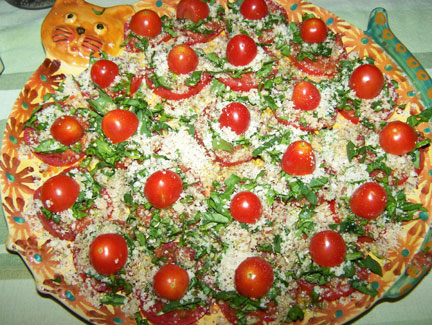
We went absolutely nuts for these little "pizzas." They were both tasty and fun. If memory serves, I believe she made them by taking slices of firm roma tomatoes, spooning on some improvised pesto sauce that she whipped up, sprinkling on some chopped basil leaves, sprinkling on some "cheese" that she made with ground Brazil nuts, garlic, and salt, and then topping each "pizza slice" off with a half cherry tomato. No recipes necessary here; just take a look at the picture & go try it!

Here's some coconutty video footage from our Florida Keys excursion. First up is some footage of Randesh, from www.TheGuana.com, who obtains fresh coconuts for Charlie Wilson's Key West restaurant, Help Yourself (see yesterday's blog post).Notice that Randesh uses a proper piece of equipment -- a large machete (or cutlass) -- which makes short, easy work of opening these precious gifts of nature! In the video footage following that, you'll see how comically difficult it is to open a young coconut when you lack the proper equipment. We actually went out looking for a machete, but could only find a large chef's knife at a local K-Mart. Yep, they were sold out of machetes! (Ironically, the chef's knife -- the heaviest one the store had -- cost about $17, while plain old machetes run just $10 or so at most hardware stores. Next time we'll keep looking...)

We may never fully comprehend the mysteries of life and death. One thing is for certain, however, with both we experience tremendous amounts of emotion.
At this moment, we are experiencing extreme sorrow after the still birth of our niece, Elizabeth Marie. She was named after my mother who died a few years ago. During this period of tremendous grief, we will be spending time with my dear sister and her family, offering our love and support.
In yesterday's installment, we talked a bit about Salem, Oregon. I inadvertently missed this video in Wendi's batch of uploads. So, here's Wendi interviewing Kerry Matson on her path to raw and some of her favorite raw foods!
Once again, we thank our trip snack sponsor, Natural Zing, for helping us to make this possible on our budget!

Jim here... Wow, it's May 1st already! May is an exciting month for me because that's usually when my running kicks in more regularly. There's nothing like hitting the pavement and being in motion, MP3 player in hand. Whether it's an intense half hour of intervals powered by the Foo Fighters, or a longer moving-meditative outing accompanied by Michael Hedges, I do enjoy being out there (even if I'm distracted now and again when my canine running companion? -- aka "the Jooge" -- chases after something she shouldn't)!
But, as I was getting at:? Ever since I lost the weight, I simply can't abide cold. I've heard many raw foodies talk about this phenomenon, and have heard numerous explanations for it. My suspicion is that all of the "why raw foodies are always cold" theories are partly correct -- or, better put, that the theories cumulatively contribute to our slightly lowered body temperature.

To help keep all of you inspired, we ve asked some
remarkable individuals to share their raw food stories with you. Enjoy!

We just returned from the East End Food Co-op, where we answered raw food questions for two hours. We were still answering questions on our way out the door, and would have stayed longer but the place was closing. ;-) So, if anyone from this evening stops by our site and you still have questions, just comment here (or send me an email) and I'll be happy to answer them.
I'm more of a one-on-one kind of person, so I was a bit nervous about sitting in front of everyone to answer questions. Jim and KDcat were there to help me, of course, otherwise I probably wouldn't have been there at all. Once people started arriving, I was comfortable. The first people who entered the room were super sweet and I could tell they were genuinely nice people. Then little by little the room filled up, and I was surprisingly comfortable.Maybe in addition to all of the other positive changes in my life, my self confidence is getting better, too!

Pure Jeevan hosts the Pittsburgh Raw Food Meetup this Sunday, November 2, at 3:00 p.m.! Click here for details and a map link. We hope you can make it. We'd love to spend time with you!
Original Comments
Below, we have included the original comments from this blog post. Additional comments may be made via Facebook, below.

Wow, is it Friday already !? Time flies when you're powered by 100% raw organic goodness! Today, we wanted to share an audio interview with you. Last night, Alex Ortner from the Movement to Reverse Diabetes Naturally interviewed us about our recent work helping them spread their message. We were honored to hear him introduce us as "two people that hold a special place in my heart right now, and I'll tell you why that is: They are probably the two most active people that we've had in the movement to reverse diabetes naturally."
Well, Alex, it was our pleasure! We met scores of new people during our work for RDN, generated major awareness about the movement, and spread the word about the raw food lifestyle as well. To listen to or download the interview, just visit their site, here. Topics covered include:

In writing and researching our previous two posts, we came across a number of articles mentioning the benefits of chlorophyll for those who have been exposed to radiation. Nothing seemed to go so far as to call chlorophyll a cure-all. But, many sources cited clear benefits -- and it's great to read about potential preventative measures and treatments available through natural means. For example, the best source we found mentioned some specific studies:
Note: This entry is not meant for our regular readers. Search engines are directing people to our page when they enter "mono and headaches" and I want to take this opportunity to reach out to those who may not know about this amazing lifestyle the rest of you already know about! ;-) Plus, I want to help them with their headaches.
Mono and Headaches: Looking for Help
Mononucleosis (Mono) is a common viral illness. When children develop mono, it is usually not obvious since it seems like a normal cold. When teens and adults develop mono, however, the symptoms are much more severe. Most individuals will feel better within about three weeks, but fatigue can continue on for about three months! Who wants to feel ill that long? Who wants to feel tired for MONTHS ! Who wants to suffer from such severe headaches ! Not me, that's for sure.

Read more: Mono and Headaches: This Entry is Not For Our Regular Readers