Know Any Literary Animal Lovers?

Hi there PureJeevan readers! We wanted to let you know that Jim's new novel CHROO is available on Amazon. It's a crazy adventure involving a billionaire heiress, her Chihuahua BFF ("Chroo") and a host of human and animal characters. Find out more on Amazon! Here are some links:
 On March 6, Wendi and KDcat arrived around dinner time at their next location, Grants Pass. We've known their hosts as online friends, so it was a real treat to meet them in person. Rebecca Leaverton, her hhusband Dominic, and their twins Aubrey and Sebastian live in a beautiful home in one of the more beautiful places W&K have visited in Oregon (and that's saying something, as EVERY location in Oregon has been absolutely beautiful). Grants Pass is surrounded by the most breathtakingly gorgeous mountains, close and ever-present no matter where you are in the city. If we ever do decide that city living isn't for us, Wendi said she'd love to live in the mountains surrounding Grants Pass!
Here's some video... In the first clip, Wendi shares a raw traveling trick she came up with -- kind of a high-energy, super-fast sandwich. Then Rebecca (aka SuperfoodGirl -- from www.SuperfoodGirl.com) demonstrates one of her favorite pieces of kitchen equipment, the V Slicer. (Wendi loved it and says we need to save up and get one when she returns from the trip.) And then we couldn't resist a few moments of footage of Rebecca's twins out exploring the kale and wheat grass in? theback yard.
Read more: Grants Pass' Great People, Giant Peaks, & General Pleasantry

I'm still doing my nine-day mono meals for Navratri. Since it's Makin' It Monday, instead of actually makin' a recipe, I'm dreamin' about it! After talking with my sweet friend Melissa, I thought I wanted to eat spinach pie when I end my mono meals. She was talking about it, shared how she was going to create it, and my mind was filling with the image of spinach pie, the smell and taste of it, and I wanted it right then.But, we don't have any spinach in the house right now. Since I end my mono meals after tomorrow's lunch, and don't have time to buy spinach at the food co-op, I decided to dream some more about what I'll be eating for tomorrow's dinner.
Then it came to me. I want beet pasta! Not just any beet pasta, but beet pasta topped with a creamy alfredo sauce! I picture it in my mind; I can imagine the taste of it, the texture, and it's so delicious. I think I want something green with it, too. Perhaps I'll start with a small salad. Ooh! Yes, that's what I'll do!
Is cacao dangerous or is it a super food? Anyone who's been learning about raw foods knows about raw cacao (check out a recent episode of Know Your Food: Cacao). It's raw chocolate without all the processing and additives normally included in the chocolate bars many buy from standard grocery stores. In its raw form, cacao has different nutritional components than typical processed chocolate. Many claim that raw chocolate is filled with mega doses of nutrients, making it a super food, and therefore extremely healthy for the human body. Others claim that even in its raw state, cacao is a stimulant that taxes the human body and cacao is more like a poison than a food. I've heard murmurs about negative effects of cacao for many years, but that was always subdued by the vociferous praise of cacao.
Recently, my friend Kevin Gianni (The Renegade Health Show) spoke out about cacao and his experiences with it. Kevin is well known in the raw food community, so his words came as a shock to many people. He explained in his video (below) that he developed a rash on his stomach. After much investigating and diet changes, he came to the conclusion that cacao was causing the rash (eliminating the cacao caused his skin to clear). He also stated that cacao had been stripping his body of vital minerals. Kevin pointed out that he was simply sharing his own experience with cacao, possibly shedding some light on a subject that may need to be further investigated. He advised others to take a look at their own reactions to the food, to see if they are experiencing any problems.

I'm pretty sure I've said this before, but I'm thankful for so many things that it could take me a very long time to list them all. Today, however, I'm focusing on how thankful I am to have loving, supportive friends in my life.
When I was a child we moved a lot (every two years, on average). I continued to move a lot even after college, when it was no longer my mother making the decisions about moving.Why am I telling you this on a Thankful Thursday ?Because all of that moving around when I was a young child partly shaped the way I made friends.
 Today's post isn't specifically about raw foods. But, we wanted to post a few videos highlighting some interesting research by an Italian doctor named Tullio Simoncini, who just might be onto something HUGE! Dr. Simoncini treats certain cancer patients with ordinary sodium bicarbonate (baking soda), based on his premise that cancer is a fungal problem and that a solution of baking soda is anti-fungal. Naturally, he's been vilified by the medical establishment for making such a seemingly simplistic claim. But, what if he's right?
Here at Pure Jeevan, we're very much into health research -- not so much with an aim to cure any specific disease or ailment, but rather to understand ways in which our bodies can become what we like to call unbalanced, as well as the ways in which we might return our bodies to proper balance, when necessary. In this way, I suppose that we, like many in the natural health world, feel that the body is amazingly capable of healing itself (in many circumstances) as long as the body is able to find a favorable state from which it can properly do what it naturally wants to -- which is to return the body to an optimal state of health.
Medical doctors don't buy into this theory very much. ?However, it's certainly ironic how, where certain areas of standard medical practice are concerned, what I described above is exactly what doctors do. Take something like a broken bone, for example. A doctor does not normally attempt to surgically repair the bone itself. Rather, the standard and time-honored practice is to set the bone (say, with a cast), and then to let your body heal the break naturally, on its own, making those skeletal connections as only the imponderably complex, ever-evolving wisdom of the human body can facilitate. (True, doctors do often intervene these days with surgery for broken bones. But, their aim there is mainly to position the bones for proper healing, and/or to do things like insert pins in an attempt to improve functionality after healing. Either way, the procedure here still relies on the body's ability to eventually heal the problem.) Standard medical knowledge in this area is without question outstanding -- and this is why most people in the natural health world have little problem with going to see a medical doctor for emergency treatment.
Read more: Is Cancer a Fungus? Considering the Work of Italian Dr. Tullio Simoncini
April 15, 2008
Every year my dear friend, Mamta, lets me know when Navratri is going to begin. ?It s the nine-day fast, but you don t have to change anything since you are already eating so healthy. Traditionally, Hindus used to abstain from eating during Navratri. In modern times, with everyone working and life being less relaxed, fasting isn t always something that can easily be accomplished. So, over the years Navratri has been modified by many to represent a time of eating more simply and abstaining from meat if you eat it.
This year, I had an email question from one of our readers who was asking about ways to eat simpler during the nine-days of fasting. After responding to him, it sparked in me a desire to do something this year for Navratri. I had read about eating mono meals and always thought it sounded like such a gentle way of cleansing the body, so I figured I d try it for the nine days of Navratri. To make it even easier on me, I decided to consume a different food every 24 yours, rather than eating the same thing for the full nine days. Maybe in the future I ll try that, but this time I wanted this to be as easily doable as possible.

Who's been making small changes and feeling a bit brighter lately, since we've been talking about brain health? Today, let's continue focusing on some things we can actively do to minimize our chances of developing memory problems like Dementia or Alzheimer's in the future.
Yesterday we focused on heart-healthy tips to increase brain function (since heart disease seems to be linked with Alzheimer's) and I shared a heart-healthy recipe with you. Today, we'll focus on inflammation.
Read more: Extinguish Inflammation: Anti-Inflammatory Recipe
In some recent Summertime Raw posts, we've focused on preparing delicious, nutritious raw foods *while* on the go. Today, however, we're doing an outing with all of the prep work done at home -- so no need to pack knives and cutting boards! We're also focusing in on a few seasonal ingredients. You'll see some really tasty uses for mint, and we'll also take a look at some wonderful edible flowers. Here's the video:
Read more: Summertime Raw: (Video) Undeniably Magical Sparkling Wonderment!
We all know what "greens" are in general. For example, no one questions whether lettuce, kale, spinach, or chard are greens. But on the other hand, all of those items *are* also clearly green in color. With that in mind, what would you make of the following two questions I (Jim) recently pondered -- tagged as "reader questions" so they're easily found in the future by other equally inquisitive people ;-) -- that seem bizarre, but are really quite interesting?
1. Are non-green greens (e.g., purple kale) still considered greens2. Are vegetables with green skins (e.g., cukes, zucchini) considered greens? (After all, they're green!)

What a fun weekend we'll be having! We leave later today to visit some friends in Virginia. Sweet little Rhia (a niece's daughter) will be turning one year old and there will be a huge party for her. I'll be wearing a sari, there will be lots of Indian food to tempt me back to the cooked side of life (but, never fear, I am strong!), and we'll be staying up very late enjoying the party Saturday evening.
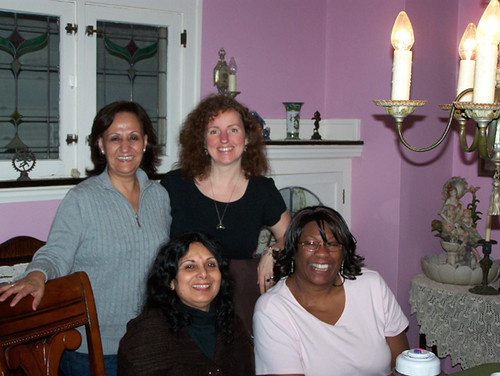
Mohtarama, Wendi, Mamta, Deborah
At a recent raw food meetup, I was surprised that so many raw foodies aren't aware of the raw almond controversy. Maybe most of our Pure Jeevan family members aren't aware of the fact that most almonds are not raw. It's sad, but very true. In 2006 a mandatory almond pasteurization ruling was created. The rule was passed sometime in 2007, I believe, and since then it's been near impossible to purchase truly raw almonds. Maybe pasteurized almonds don't seem like a big deal to most people.
Raw almonds are alive, yet dormant until they are soaked. Once soaked (or moistened in the springtime rains when outdoors), they sprout to begin growing into almond trees. Once soaked and sprouted, the nutritional content of the nuts change significantly. They are alive and filled with protein and so much more!