Know Any Literary Animal Lovers?

Hi there PureJeevan readers! We wanted to let you know that Jim's new novel CHROO is available on Amazon. It's a crazy adventure involving a billionaire heiress, her Chihuahua BFF ("Chroo") and a host of human and animal characters. Find out more on Amazon! Here are some links:
We at Pure Jeevan are making MAJOR life changes!
Did you think our lives solely revolved around raw foods---that once we went raw, there were no more major life changes to be experienced? Well, maybe it's true that our lives do, in a way, revolve around raw foods---they give us the health and vitality necessary for living a truly vibrant life! However, we are each (Jim, KDcat, and Wendi) unique and interested in many different things. Somehow, we pull all of our differences together and stand united as a loving family. It will be together, as a family, that we embark on an amazing MAJOR life change.
A few of you may already know what I'm talking about, but the rest of you are about to find out all about it, too! You may have noticed that we've temporarily discontinued many of our raw food services---for those of you who have written to ask for help, I am still responding to your emails. If I can't help you at this time, I'll do everything I can to assist you in finding the help you need. This was a necessary part of preparing for the change that is about to take place. In addition to cutting back on our services, we may not always be consistent here with our blog postings, and our email responses may not be very timely (as some of you may have already noticed). We will answer your emails, however, so please don't stop sending them to us. Hearing from all of you makes my heart fill with love and happiness!

I'm in the mood to eat lemons, so I figured for today's Makin' It Monday I'd search the Net for some lemon recipes. Well, look what I found!


Welcome to Pure Jeevan's "Juice-a-Day Jamboree"! You're probably wondering, "What IS Pure Jeevan's Juice-a-Day Jamboree, anyway "? Well, it's simple:? It's an ongoing, informal, loosely organized "event" centered around juicing. Think of it as an interim step between (1) any kind of diet or lifestyle, from SAD to full-on raw, that does not include much regular juice, and (2) an all out juice feast where that's ALL you'd consume for a period of time. Basically, we're saying, "Let's just make this simple and accessible for everyone. Let's just make a goal to simply drink more fresh juice!"
Wendi and I have been thinking a lot about incorporating more juicing into our lives lately (which is something we've done off and on over the years but never stuck with long-term). One thing holding us back from doing it more often is the time requirement. When we juice, it usually takes a half hour or so from start to finish. I know it doesn't seem that complicated, but I suppose it's just the whole process of setting up the juicer, washing and peeling the produce, juicing it, setting the juice aside while we clean the juicer, doling out the juice into glasses, cleaning up the mini-mess that makes, and then sitting down to actually enjoy the juice.

Jim here... I was listening to a radio commercial the other day that promised to reveal the "secrets that credit card companies DON'T want you to know." You hear that kind of rather manipulative marketing all the time, right? It's a psychological thing, I suppose -- filling your mind with intrigue almost instantly. My credit is pretty decent, but I was thinking, "Wow, I wonder what those secrets are?!" We humans are curious creatures, aren't we?
But then I started to laugh to myself, imagining a raw foods radio spot adopting that technique. "Buy our special report and learn all of the Secrets that Raw Foodists do NOT Want YOU to Know!!!" And then I laughed some more. Know why? Because, when you think about it, there are absolutely, positively NO secrets raw foodists don't want you to know! Isn't that stunningly cool? In fact, the entire message of the movement is conveniently included right there in the words "raw foods." It couldn't be simpler -- the cure for what ails so much of the planet, neatly summed up in two words.
As promised, here's our interview with Leigh Crizoe, Rhio's partner and co-host of the Hooked on Raw Internet radio program. We think you'll love this interview, as it shows another perspective on raw foods and also gets into an interesting detox program that you may not have heard about. After 9/11, the New York City residents and workers close to ground zero breathed in highly toxic particulate matter for a long span of time. Rhio and Leigh live just blocks from the site, and both experienced respiratory troubles as a result -- especially Leigh, whose sweat began to stain his white t-shirts black! (Yep, you read that right: You'd actually sweat black! This happened to many ground zero workers, in fact.)
Who had the detox answer for them ?... Would you believe L. Ron Hubbard and Tom Cruise ? Apparently, detoxification was an area of high interest to Hubbard, the founder of scientology, who developed an intense regimen of saunas, vitamin supplements, and oils, all specifically for the purpose of ridding the body of toxins. According to Leigh, Tom Cruise personally funded and co-founded the New York program (which has proven highly successful!) after 9/11. (The official site for that detox program is here.)? Super-interesting stuff -- be sure to watch the video.

We tried it in the past, this most unusual fruit. While in Chicago recently, we decided to give it one more try! You see, the first time we tried it we were ... let's just say "not big fans" of the infamous durian. (Here's an episode of Kevin Gianni's Renegade Health Show, shot in our home, documenting that day.) It's a stinky fruit to most, although some claim to enjoy the bizarre odor (which is sometimes described as dirty sock and propane gas smell). If you can get past the smell to give it a taste, you'll be greeted by a taste as strange as the odor. Wendi describes it as a sweet onion pierogie, but each person seems to have a different opinion about this odd fruit.
In this current video our raw friend Debbie Gedayloo-Bennett, whom we met in Chicago, jumped at the opportunity to hang out for a bit of a durian experience. Debbie is on the pro-durian side of the fence that divides those who love and those who hate the alien-like fruit. Wendi was still sitting on the fence, not making up her mind after the initial taste with Kevin and Annmarie. Jim was adamantly sitting far from the love side of the fence, refusing to even attempt approaching the pro side. Debbie was a pro in opening this spiny fruit, so she agreed to open it while on video so that we could share the experience and knowledge with all of you.
I started writing on a raw food forum about the oranges coming in today. But, I was on my way out the door and I had more to say about them than I realized, so, I figured I'd paste what I wrote, so far, and add to it here in our blog. ;-)
?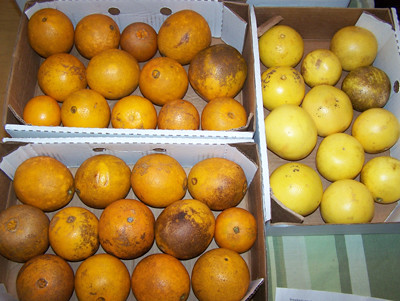
(organic oranges and grapefruits)
Jim here... Since we posted Wendi's two-part series on pasta-making techniques (part 1, part 2) last week, I thought I'd follow up with an additional novel use for the spiralizer -- super-delicious, blazingly fast, ultra-low-fat sweet potato chips! We've done some really great things with sweet potatoes before. (Anyone signed up as a member of the Pure Jeevan family has likely already received our prized sweet potato pancake recipe.) But, these chips are amazing because they satisfy that unmistakable urge for crunchy, healthy snacks -- and in record time. Friends, if you have a dehydrator and sweet potato on hand, you could literally be enjoying these things in under three hours. So let's get going!
As Wendi demonstrated in the videos last week, you can easily make "rounds" using the spiralizer by simply making a vertical slice throughout your vegetable prior to placing it on the spiralizer. So, if we were looking down at the sweet potato, the cut (which goes all the way down the length of the vegetable) would look like this:
Read more: Super-Delicious, Blazingly Fast, Ultra-Low-Fat Sweet Potato Chips!
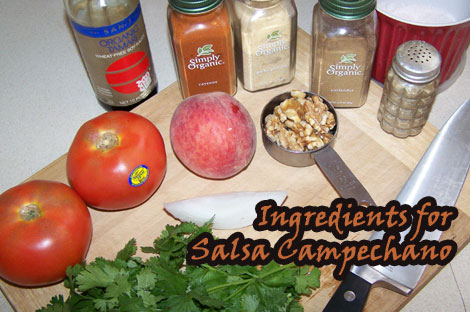
For today's Makin' It Monday feature, we'd like to present "Salsa Campechano." We'll have to admit, though, that we do not speak Spanish. So, we have to give some credit to Google's online language translator. When we went to name this recipe, Wendi suggested that this is a "manly" dish (since I created it). However, we didn't find the perfect Spanish word to fit the recipe.Then, considering the walnuts in the recipe, Wendi suggested that perhaps "hearty" was a better adjective. Google returned the Spanish word campechano for this, and we immediately thought: Yes!, that sounds just perfect!? So, here's an amazing recipe for you. It's a hearty salsa recipe, but I actually like to eat it as a soup.

Today we'd like to introduce you to one of the sweetest, most creative, and passionate raw foodists we know. She's petite, pretty, pleasant, powerful! She continually shares her knowledge about the raw food lifestyle with others and educates many individuals about our human rights when it comes to the foods we grow and consume. She's up on the latest regulatory activities relating to health and diet issues going on within the US government, and speaks out when our rights are in jeopardy of being taken away.
Take the Time to Meet... Rhio!

 Here's the next component in our raw taco recipe -- the guacamole. This is Wendi's favorite component! Enjoy!!!