Know Any Literary Animal Lovers?

Hi there PureJeevan readers! We wanted to let you know that Jim's new novel CHROO is available on Amazon. It's a crazy adventure involving a billionaire heiress, her Chihuahua BFF ("Chroo") and a host of human and animal characters. Find out more on Amazon! Here are some links:

Wow, are you in for a treat! I came up with the most delicious soup recipe today! I wanted to make something that didn't require use of the food processor, blender, or dehydrator because I've gotten quite a few emails saying that it's too hard to be raw if you don't have the money for the appliances.
I disagree that it's too hard to be raw without the appliances. It's definitely easier to do it *with* the appliances, but it's not overly hard to do it without. So, from time-to-time I'll try to create recipes that don't use anything more than a knife and a chopping board to show you that it's not too difficult to eat raw. :-)
If you've been following us for some time, you'll know that we are continually working on projects that will either serve our raw food community or educate others about the health benefits of a raw food lifestyle. If you are new here, or just getting to know us, you can read a summary of what we accomplished last year and a summary of the projects we're currently working on. We're serious about our goal to inspire others to learn about and embrace the raw food lifestyle and community. I've always been someone who helps others, who senses in what direction they are headed and then offers inspiration to keep them moving. I love the work we do as Pure Jeevan and it is extremely rewarding to receive so much gratitude from many of you. But, guess what? Sometimes I get tired!
Sure, some of you may be saying, "But, wait! People who eat raw foods are supposed to be power houses of energy -- able to continually keep active and never run out of steam." Well, that is very true. So, I take it back. I'm not really "tired" like I said -- my body is able to wake up in the morning, easily fall asleep in the evening, and go about its daily work without feeling like it's run down.However, I am feeling like I need a rest from all that I've been doing. Maybe I don't need to sleep hours and hours, because my body isn't truly tired. None of my being is truly tired -- my body, mind, spirit, and emotions are feeling great, actually.
However, I still feel like I need a break from my routine. On top of that, I've been feeling uncomfortable in the cold weather even more this year than I did last year. It hurts all the way down, deep inside my bones. I feel like it will take a lifetime to thaw from the cold I've been feeling here in Pittsburgh. The sun rarely shines, and the snow and ice are brutal on someone eating only raw foods. My instincts told me two years ago that it was time to move to a warmer, sunnier climate, but that hasn't happened yet (even though we are patiently working on it, as Jim pointed out in an earlier post).
Continuing on, again, with Wendi s San Francisco travelogue:
After leaving Pete and Blessing, we had a little time before our next meeting. So, KDcat and I explored San Francisco a bit. We saw the largest rainbow flag we've ever seen, experienced the steep hills (much steeper than the ones in Pittsburgh), and checked out an overview spot called Twin Peaks. Our San Francisco host taught us later that evening about how to "curb" your car and always apply the parking brake (which is necessary in a place with such steep hills).
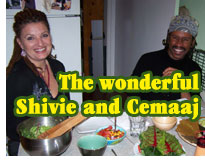 Later we met up with Shivie and Cemaaj, who heard we'd be in town and invited us to visit them for a raw meal? in their home. Wow, what a delicious and beautiful meal we were served! Shivie and Cemaaj are gentle, loving people with a true gift for preparing and serving gourmet raw foods. We were honored to be invited to visit with them and loved them both instantly. They were a lot of fun getting to know, and very generous (sending raw foods with us before we left to eat and share with our San Franciso host). Cemaaj is also a gifted musician and taught KDcat some rhythms on the djembe African drum, which she quickly learned and enjoyed very much! Cemaaj is a gifted teacher and great with kids. It was fun watching him ease her into the instrument, which she now says she'd love to own and practice on!
Read more: Part 3 of 4: Glowing Gypsy Gals Glimpse the Glorious Golden Gate's Gastronomical Goodness
Jim here again... So, instead of Episode 1 of "Know Your Food," we present Episode 0.5, which documents the high drama of launching a video blog. Quite intense, my friends... Recall yesterday's installement -- when we captured the initial moment of inspiration in our library? Well, today's installment is a "confession cam" one, just like you see on every reality TV show ever produced.
The question is: Will we EVER actually launch our nutritional web show? Stay tuned...
Read more: Pure Jeevan Nearly Launches New Series. See Episode 0.5.
And here's the conclusion of Wendi's San Francisco travelogue:
 That evening we met up with Carolyn, a long-time friend since college, who was our lovely host for a few days. Carolyn has a gift with cats, which was a real treat for KDcat to see. Do you know how you can teach dogs to sit and give kisses? Well, Carolyn has taught one of her rescued cats to do the same thing! He *really* sits and *really* gives kisses on command! WOW!
Carolyn showed us all around the San Franciso and Berkeley areas, bringing KDcat to a thrift shop (she's been having fun popping into random thrift shops to see what she can find) and a fun shop called Ancient Ways, stopping by some Indian shops so I could pick up some more bindis and some ground coriander for a dish I made while visiting, checking out the Berkeley campus area, and taking us shopping for organic foods.
Read more: Part 4 of 4: Glowing Gypsy Gals Glimpse the Glorious Golden Gate's Gastronomical Goodness

Yesterday's smoothie was superlatively tasty, eh? It was clearly something out of Elvis' more energetic younger years, I think. You're probably wondering: "How does one follow an Elvis smoothie?!" I know ... it'll be tough to do.
Read more: Protein Powder Smoothies Part 3 of 3: The Donald Smoothie

Do you know how sometimes you meet somebody new and they tell you their name and it just doesn't seem to fit for some reason? Well, that's just not the case for the person that we'd like to introduce to you today. This person's name describes the individual she is as well as the community that she creates.
Take the Time to Meet? Happy Oasis!
In this special five-part series, Joanna Steven uncovers where some top vegetarian athletes get their protein. Here's part one, focusing on Tim VanOrden's take on this issue.
When alternatives to the Standard American Diet are discussed, protein is on everyone's mind. There are many reasons why someone might want to eat a plant based diet, whether for allergy concerns, health reasons, or more variety. But nagging doubts often come up;? Are plant proteins adequate for athletes and body builders ? Are they really the preferred protein source of the human body ? Are they better than animal based protein or are they just consumed for environmental reasons ? To answer these questions, why not ask the experts:? triathletes, professional dancers, bodybuilders and extreme sport racers ? Here are the answers from some of the most competitive athletes in their respective fields.
Read more: Vegetarian Athletes Share: Top 5 Sources for Animal-free Protein (Part 1 of 5)
Recently, we were asked how to balance meals when one individual is an under-weight-open-to-raw-semi-carnivore and the other is overweight and feels the need to be on a raw food diet to lose weight and regain health.
Many of you reading this will agree: It's wonderful that the partner is open to the raw food diet! That's going to make life so much easier. Many on the raw food path lack a supportive partner, and that's an issue we've discussed in the past here on the blog and will continue to address in the future.

Last year when I organized a raw food spiritual retreat at an ashram, I met some very lovely people. Two of those individuals were Patty and Denny (you can visit their blog to say hello to them). They were new to gourmet raw foods, so they were enthusiastic learners at the retreat. When they returned home after the blissful weekend, they began using their new raw food knowledge. Here are some excerpts of emails I have received from them since the retreat last year:
Well, you said you're motive in putting on this retreat was simply to pass on this valuable information and to help others; you were very successful where we're concerned - it is no exaggeration to say that you have changed our lives forever.
We've been almost 100% raw since the retreat. ... We're so excited about this new way of eating that we bought a new Vita-Mix. ...We can actually say that this has been our most notable and enjoyable dining experience - ever, in our entire lives! No one would ever put that much work into something if it were just for money; it is obvious that you did it from your heart. We feel blessed to have received such a gift.

To keep all of you inspired while we are away, we've asked some
remarkable individuals to share their raw food stories with you. Enjoy!